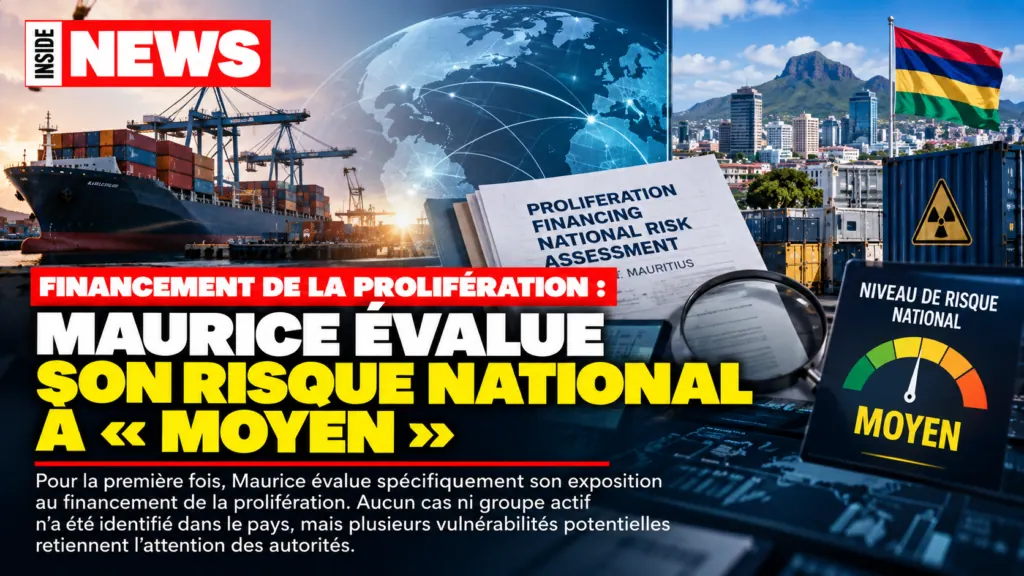
Mauritius has completed its first Proliferation Financing National Risk Assessment, a crucial step in its international financial surveillance framework. The assessment evaluates the country's exposure to financing of proliferation, which involves financial mechanisms that could contribute to the development, acquisition, or transfer of technologies and materials related to weapons of mass destruction. The country's risk level is classified as "medium," indicating potential vulnerabilities that require attention.
The assessment did not identify any active cases or groups involved in proliferation financing in Mauritius. Instead, it highlights several indirect threats, including transactions with high-risk jurisdictions, ship-to-ship operations, the acquisition or transit of dual-use goods, and the potential use of virtual assets. These factors could be exploited to circumvent international financial sanctions, emphasizing the need for vigilance in various sectors, including finance, commerce, and transportation.
The evaluation also underscores the importance of monitoring individuals and entities subject to targeted sanctions by the United Nations Security Council. While certain activities may not be inherently illegal, they may require additional scrutiny to prevent the misuse of legitimate commercial or financial channels. This assessment is not about identifying established criminal activity but rather about analyzing potential risks and vulnerabilities.
For Mauritius, a major international financial and commercial center, the stakes are high. The country's reputation depends on its ability to demonstrate that it can identify, control, and monitor transactions that pose a particular risk. Various stakeholders, including banks, financial professionals, and international trade enterprises, will need to heed the recommendations arising from this assessment to ensure compliance and maintain the country's financial integrity.
The concept of proliferation financing encompasses a broad range of activities, extending beyond traditional banking to include commercial flows, international structures, virtual assets, maritime transport, and goods with dual civil and strategic uses. Given its strategic position as a global financial hub, Mauritius must carefully manage these diverse risks to maintain its standing in the international community.
By taking proactive steps to assess and mitigate proliferation financing risks, Mauritius aims to reinforce its commitment to international financial standards and cooperation. This effort is not merely about regulatory compliance but also about safeguarding the country's financial sector from potential exploitation. The authorities have made it clear that they are taking a proactive approach to addressing these challenges.
The medium-risk classification for Mauritius serves as a reminder of the need for continued vigilance and cooperation among various sectors. Key points from the assessment include the identification of potential vulnerabilities, the importance of monitoring high-risk transactions, and the need for stakeholders to adhere to recommendations to prevent the misuse of financial channels.
Key points
- Mauritius has assessed its national risk of proliferation financing as medium.
- The assessment identified potential vulnerabilities but no active cases of proliferation financing.
- The country's financial sector must adhere to recommendations to mitigate risks and maintain its international reputation.