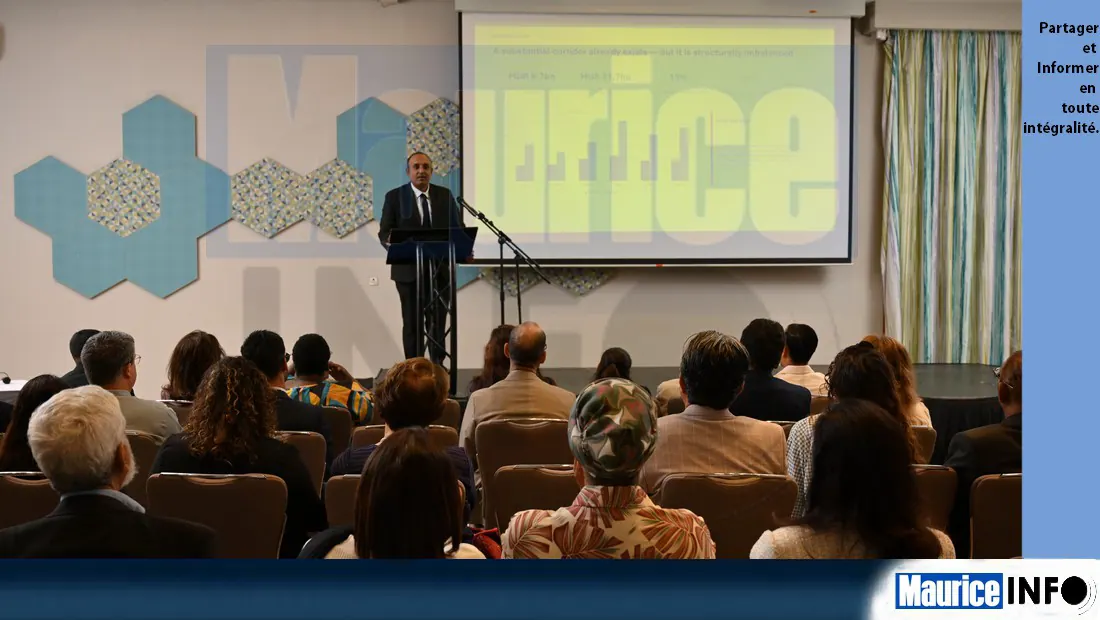
The Mauritius Chamber of Commerce and Industry (MCCI) and Wesgro, a South African trade promotion agency, recently hosted the South Africa-Mauritius Business Forum in Ebène, Mauritius. The event brought together Mauritian and South African businesses to explore opportunities for collaboration and investment. The MCCI emphasized the need for a more comprehensive relationship between the two countries, extending beyond trade in goods to include joint production, services, and investment.
A delegation of South African companies, led by Wesgro, attended the forum, representing various sectors such as food and beverages, agro-processing, and manufacturing. These companies are seeking distributors, partners, and buyers in the Mauritian market. Their products range from gluten-free and vegan preparations to food oils, charcuterie, and beverages. The South African companies will engage in B2B meetings and site visits on October 7 and 8 to further explore business opportunities.
Brandon Jenniker, Trade Manager (Africa) at Wesgro, highlighted the natural partnership between Mauritius and the Western Cape. He emphasized that the companies accompanying him are looking for long-term relationships and that the Southern African Development Community (SADC) and the African Continental Free Trade Area (AfCFTA) offer a common framework for trade. Jenniker stated that Wesgro's role is to help transform these initial contacts into tangible business opportunities.
Since 2020, South Africa has been Mauritius' primary export destination. In 2025, South Africa accounted for 13% of Mauritius' total exports and 44% of its African exports. However, the trade balance favors South Africa, with Mauritius exporting an average of Rs 9.7 billion annually and importing Rs 21.7 billion, mainly petroleum products, live cattle, and vehicles. Mauritian exports to South Africa are highly concentrated, with clothing accounting for Rs 5.9 billion, nearly half of Mauritius' global clothing exports.
The MCCI believes that the existing trade relations between Mauritius and South Africa can be built upon to create higher-value-added products. Drishtysingh Ramdenee, Secretary General of the MCCI, emphasized that the next step is to produce together, invest together, and export together. He stated that Mauritius is not an alternative to South Africa but a complement, offering a platform for services, financial structuring, and access to markets, backed by political and legal stability.
Several sectors have been identified as having potential for complementarity, including textiles, agro-processing, pharmaceuticals, and the ocean economy. The MCCI estimates that the untapped commercial potential between the two countries is significant, with $57.9 million in clothing, $30.1 million in cotton fabrics, and $29.1 million in processed fish products. The services sector is also expected to play a growing role in the relationship, with South African companies increasingly using Mauritius to coordinate and manage their investments across the continent.
The MCCI highlighted that Mauritius offers access to various preferential markets, including the Indian market under the CECPA agreement and the Chinese market under a free trade agreement. The country also offers a competitive business environment, with a 3% tax rate for export-oriented companies and a network of double taxation conventions and investment protection agreements. However, Ramdenee cautioned that accessing these markets requires careful consideration of rules of origin, tariff schedules, and customs requirements to ensure that investments are transformed into real economic activities in Mauritius.
Key points
- - Strengthening economic ties between Mauritius and South Africa beyond trade in goods. - Exploring opportunities for joint production, services, and investment. - Identifying sectors with potential for complementarity, including textiles, agro-processing, and the ocean economy.