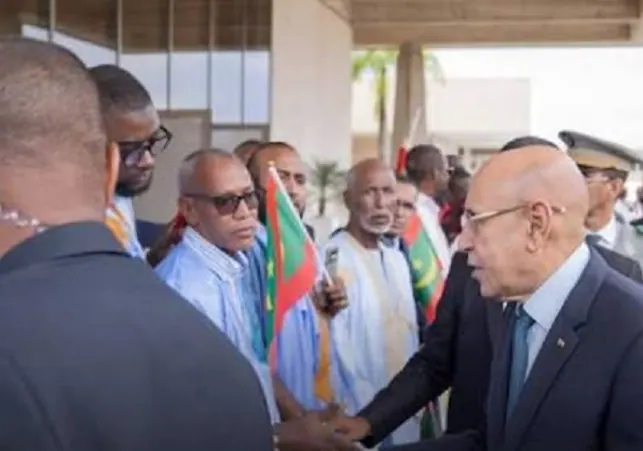
Mauritanian President Mohamed Ould Cheikh El Ghazouani has been touring the country's regions, delivering speeches that emphasize national unity, development, and the fight against corruption. His messages have been tailored to address specific local concerns, showcasing an adaptive communication strategy. In the Hodh Chargui region, Ghazouani declared the advent of the "Mauritanian citizen," rejecting tribal, regionalist, or racist discourse. This declaration was seen as a significant statement in a region where tribalism has historically been prevalent.
Ghazouani's speeches have been marked by a consistent ideological foundation, focusing on national unity, equity, and the fight against corruption. He has also emphasized the importance of dialogue and citizen participation in public management. In the Gorgol region, he highlighted the need for political elites to avoid discourse that threatens social cohesion. The President's visit to Atar was framed as an effort to ensure equitable resource distribution and involve local populations in priority-setting.
The President's choice of regions and speech content appears to be deliberate, with each territory serving as a resonance chamber for targeted political messages. The Gorgol region, particularly Kaédi and Monguel, has been a focal point for his reforms, including the École Républicaine. During a visit to Kaédi, Ghazouani expressed regret for not being able to address the population in local languages, Pulaar and Soninké, acknowledging their importance as national languages.
Ghazouani's speeches have also addressed regional specificities, such as economic development and infrastructure projects. In the Adrar region, he emphasized the need for private sector investment, job creation, and population retention. He announced the creation of a national agency for oasis development, tailored to the region's realities. In the Trarza region, Ghazouani focused on infrastructure projects, including the Rosso bridge, and launched national agricultural campaigns.
Despite Ghazouani's efforts to engage with local populations and address regional concerns, his promises have been criticized as unfulfilled. The opposition and his detractors argue that his speeches are ineffective, as they are not followed by tangible actions. In Kaédi, for example, promised socio-economic development projects have not materialized, leaving the city struggling with poverty.
The President's unfulfilled promises have been highlighted in various regions, including Néma, where the local dairy factory faces supply shortages, and Timbédra, where commitments to support the livestock sector have not been kept. Critics argue that Ghazouani's speeches have become repetitive and lacking in concrete actions, leading to skepticism about his administration's ability to deliver on its promises.
As Ghazouani's presidency marks its seventh year, the criticism surrounding his unfulfilled promises is likely to intensify. The President's communication strategy, while adaptive and tailored to local concerns, appears to be insufficient to address the country's deep-seated issues. The effectiveness of his administration will continue to be scrutinized as he navigates the complexities of Mauritania's development challenges.
Key points
- President Ghazouani's speeches emphasize national unity and development but are criticized for lacking concrete actions to back up his promises.
- The President's adaptive communication strategy has been tailored to address specific regional concerns, but critics argue that his promises remain unfulfilled.
- Ghazouani's administration faces skepticism about its ability to deliver on its promises, with criticism likely to intensify as his presidency marks its seventh year.