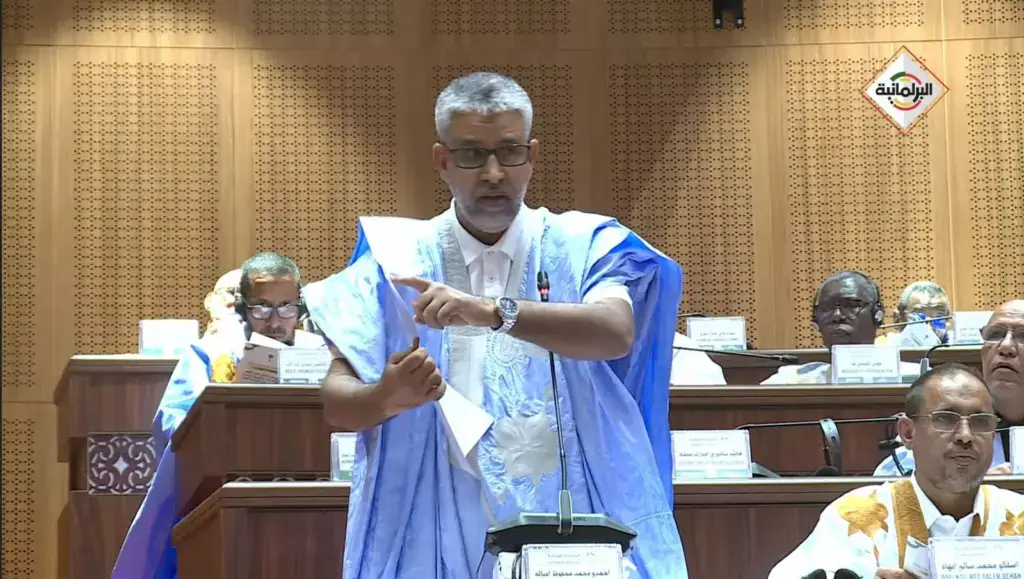
Mauritania's parliamentarian Ahmedou M'Balla from the "Tewassoul" party revealed that a significant 81% of the country's major public projects have exceeded their initial deadlines. These projects, with individual costs surpassing 80 million ouguiyas, have faced substantial delays. M'Balla made these remarks during a National Assembly session focused on examining and voting on the program of Prime Minister Moctar Ould Diay.
The parliamentarian expressed concerns about the underlying causes of these repeated delays, the responsibility of involved actors, and the effectiveness of measures taken to correct these dysfunctions. He strongly criticized the government's performance in managing essential public services, highlighting the continuous rise in the cost of living and persistent obstacles citizens face in accessing basic services, particularly in healthcare and education.
According to M'Balla, the education and health sectors fall short of the population's expectations, with a severe shortage of medications and teachers. He also pointed out significant disparities in service quality between the capital, Nouakchott, and the country's interior regions. The parliamentarian emphasized that evaluating the government's general policy should not be used as a pretext for self-satisfaction or praise but rather as an exercise in accountability for the actual results of implemented programs and their concrete impact on citizens' daily lives.
M'Balla questioned the management of financial resources allocated to these delayed projects and requested clarification on the executive's decisions to catch up on the observed delays. He concluded by stressing that the daily constraints faced by the population reflect a social reality that cannot be overlooked during the overall evaluation of government actions.
The deputy from Tewassoul urged for a genuine assessment of the government's policies, focusing on their tangible effects on the population. He argued that it is essential to address the root causes of these delays and inefficiencies to improve public service delivery and meet citizens' expectations.
Ahmedou M'Balla's statements reflect growing concerns about the government's ability to manage and implement large-scale projects effectively. His criticism highlights the need for greater transparency and accountability in the management of public resources and projects.
The Mauritanian government's response to these criticisms and its efforts to address the issues raised by M'Balla remain to be seen. The effectiveness of its measures will likely be closely watched by citizens and parliamentarians alike, as the country seeks to improve its public services and infrastructure.
Key points
- 81% of Mauritania's major public projects are delayed.
- The delays have significant implications for public services, including healthcare and education.
- The parliamentarian called for greater accountability and transparency in the management of public resources and projects.
Reporting sources
- Assemblée nationale : Le député Ahmedou M’Balla dénonce le retard de 81 % des grands projets en Mauritanie · Le Quotidien de Nouakchott