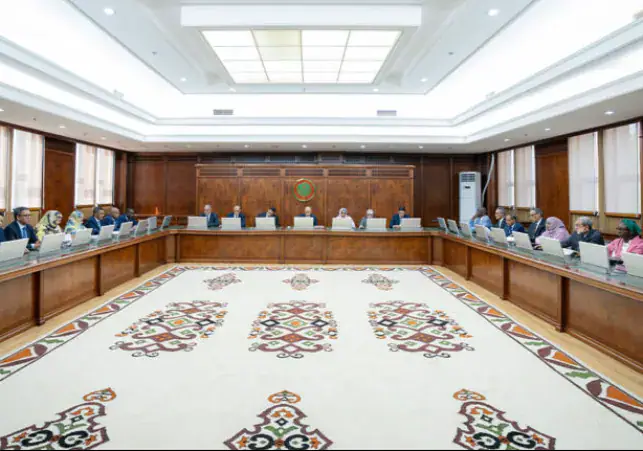
The Mauritanian Council of Ministers, under the presidency of Mohamed Ould Cheikh El-Ghazouani, met on November 18, 2026, and adopted several key projects, including a law aimed at modernizing and organizing the country's craft sector. This law, which repeals and replaces the 2003 craft code, seeks to update the sector's organization, clarify the legal status of its actors, and support its economic development.
The new law defines craft activities and professional statuses, including those of qualified craftsmen, master craftsmen, and apprentices. It also simplifies the sector's organization by structuring it around a National Chamber, regional federations, cooperative unions, and cooperatives. Furthermore, the law regulates the practice of the profession by requiring craft professionals to be registered in a national register and obtain a professional card.
The law provides for support to craft enterprises, enabling them to benefit from advantages granted to investments, small and medium-sized enterprises (SMEs), and start-ups under certain conditions. It also allows for a preference margin in certain public supply and service markets. Additionally, a Craft Support Fund will be created to finance actions promoting and developing the sector.
The law emphasizes the organization of training under the supervision of a master craftsman, recognition of professional qualifications, and priority given to citizens in employment, with equal qualifications. It also strengthens control by authorizing sworn agents to exercise control missions, defining applicable offenses and sanctions.
The law allows a maximum period of three years for craft professionals and enterprises already in operation to regularize their situation in accordance with its provisions. This aims to facilitate a smooth transition to the new regulatory framework.
Alongside the craft sector modernization law, the Council of Ministers approved several other key projects, including a decree reorganizing the University of Islamic Sciences into a more comprehensive and multidisciplinary University of Aïoun, and decrees regulating the pharmaceutical sector, including the promotion of medicines, advertising control, and the conditions for the manufacture, importation, storage, distribution, and dispensing of cosmetic and body hygiene products.
The Council also approved a decree granting twenty-five research permits for substances in group 2 to mining companies, as part of efforts to modernize the mining cadastre, resolve pending cases, and improve the processing of mining title requests. These decisions reflect the government's commitment to developing various sectors and improving the business environment in Mauritania.
Key points
- The new law aims to modernize the craft sector by clarifying the legal status of craft professionals and supporting economic development.
Reporting sources
- Au Conseil des ministres : Un projet de loi visant l’organisation et la modernisation du secteur de l’Artisanat · L'Authentique (Mauritania)