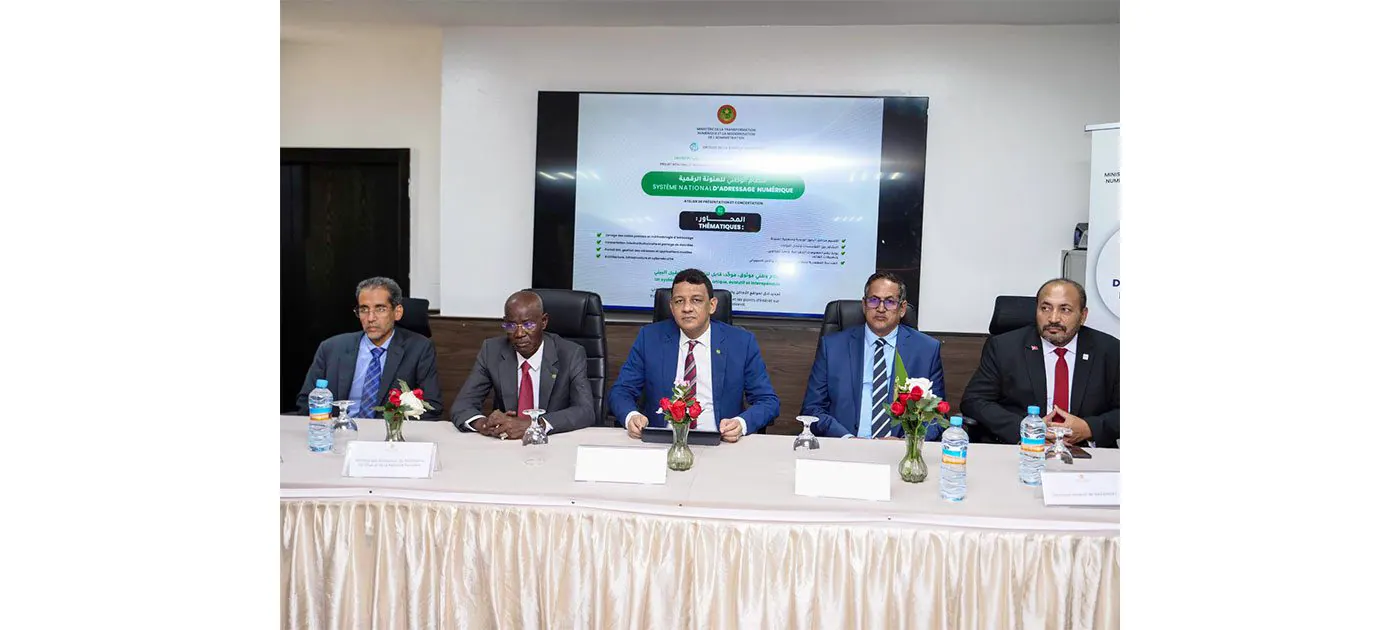
The Mauritanian government has initiated a four-day workshop in Nouakchott to present the National Digital Addressing System and solicit feedback. The event was inaugurated by Minister of Digital Transformation and Modernization of Administration, Ahmed Salem Ould Bede, and Minister of Real Estate, State Property, and Land Reform, Mamoudou Mamadou Nyanng. The workshop aims to establish a unified national infrastructure for geographic and digital addressing, aligning with standards set by the Universal Postal Union.
The National Digital Addressing System is part of the Regional Program for Digital Integration in West Africa, funded by the World Bank. According to Minister Ould Bede, the system will provide a reliable and unified national reference for addresses, enabling precise location identification of land plots, buildings, facilities, and points of interest across the country. This initiative is a key component of President Mohamed Ould Cheikh El Ghazouani's "Ambition for the Country" program, focusing on digital transformation and improved public services.
Minister Ould Bede emphasized that a precise address is essential for daily life, economic activities, and public services. A reliable addressing system will facilitate citizens' access to public services, improve location identification for economic activities, and enhance postal and logistics services, e-commerce, and emergency response. The system will also enable public administrations to better connect databases, identify infrastructure locations, and develop urban and territorial planning.
The National Digital Addressing System will not only assign identifiers to locations but also adopt an integrated approach, including postal code division into zones, a methodology tailored to urban and rural areas, and the creation of a coherent network infrastructure. The system will provide specialized digital tools for address management, updating, and exploitation. Minister Ould Bede stressed that the system's effectiveness relies on three core principles: unified reference, interoperability, and scalability.
The success of this project requires collaboration and coordination among various ministerial sectors, regional groups, and entities responsible for real estate and urban planning. The minister emphasized that a national addressing system can only be effective and sustainable through a combined effort. The workshop was attended by the Secretary-General of the Ministry of Digital Transformation and Modernization of Administration, the coordinator of the Regional Digital Integration Project in West Africa, and representatives from relevant sectors and entities.
The National Digital Addressing System is expected to improve the connection between public administrations' databases, identify infrastructure and equipment locations, and enhance urban and territorial planning. For local communities, the system will facilitate the identification of neighborhoods, streets, and buildings, providing a unified base for managing proximity services and improving local planning.
The Mauritanian government aims to establish a robust and sustainable national addressing system, aligning with international standards. The system's implementation is expected to have a positive impact on the country's development, improving public services, economic activities, and citizens' daily lives. The workshop will provide a platform for stakeholders to discuss and provide feedback on the National Digital Addressing System.
Key points
- The National Digital Addressing System will provide a unified national reference for addresses, enabling precise location identification across the country.
- The system will facilitate citizens' access to public services, improve location identification for economic activities, and enhance postal and logistics services.
- The success of the project relies on collaboration and coordination among various sectors and entities.