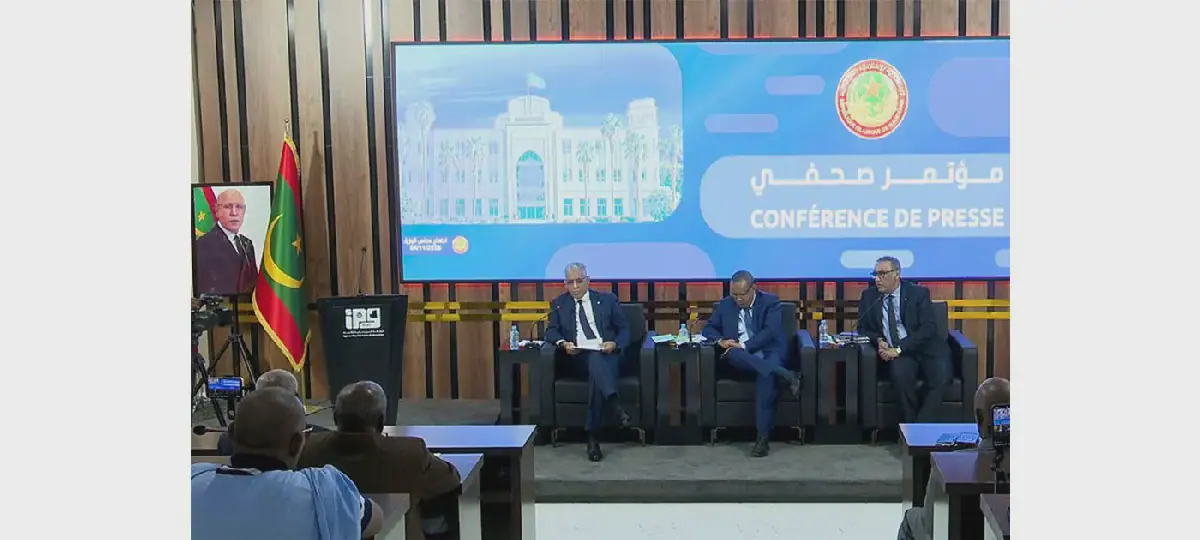
Mauritania's Minister of Culture, Arts, Communication, and Relations with Parliament, Mohamed Ould Baban, emphasized that the country is closely monitoring regional developments while maintaining its stance of positive neutrality. He stated that Mauritania considers itself part of the solution, not part of the problem. This statement was made during a press conference following a cabinet meeting, where he was accompanied by the Ministers of Economic Development and Higher Education.
The Minister addressed the state of private press and public media support, highlighting the government's openness to private media institutions alongside efforts to develop public media. He stressed that enhancing the media landscape requires strengthened partnerships between public authorities and press institutions, as well as interaction with initiatives aimed at professional organization and performance improvement. The Ministry is consulting with media stakeholders on support mechanisms and fund outcomes.
Minister Ould Baban reviewed projects and decrees approved by the cabinet, including sectors such as economic development, finance, higher education, and scientific research. His counterpart, Minister of Economic Development Mohamedou Ahmedou Imhimid, outlined key aspects of the new public procurement reform. He noted that the draft decree implementing Law 026-2026, which includes the public procurement code, marks a crucial step in modernizing and enhancing the efficiency of public procurement.
The public procurement reform aims to update the public contracts system, promote transparency, and ensure good governance. The reform was developed through a consultative approach involving various stakeholders, including regulatory and supervisory authorities, contracting authorities, public procurement committees, the private sector, civil society, and technical and financial partners. The first phase of the reform involved issuing Law 026-2026, while the draft decree represents a complementary phase.
The reform includes restructuring the public procurement regulatory authority, now called the "Public Procurement Regulatory Authority," with expanded roles and enhanced powers. It also involves developing a monitoring system by strengthening the powers of the Public Procurement Monitoring Committee, now called the "National Public Procurement Monitoring Committee." A national observatory for public procurement will be established to collect and produce reliable data.
The reform prioritizes transparency and anti-corruption measures, including asset disclosure requirements for stakeholders and the gradual digitalization of public procurement procedures. It aims to reduce the timeframes for various stages of contract conclusion and implementation, accelerating the completion of development projects. The reform also supports the national economy by granting preferences to national institutions.
Minister of Higher Education and Scientific Research, Yaacob Ould Amein, presented a draft decree establishing a special system for higher education teaching and research staff. The draft decree aims to unify legal texts governing these careers, providing a coherent framework tailored to the specificities of higher education. The project combines four professional networks within a unified regulatory framework.
Key points
- Mauritania reaffirms its commitment to positive neutrality amid regional developments.
- The country is implementing public procurement reforms to enhance transparency and good governance.
- A new system for higher education teaching and research staff is being introduced to unify legal texts and frameworks.