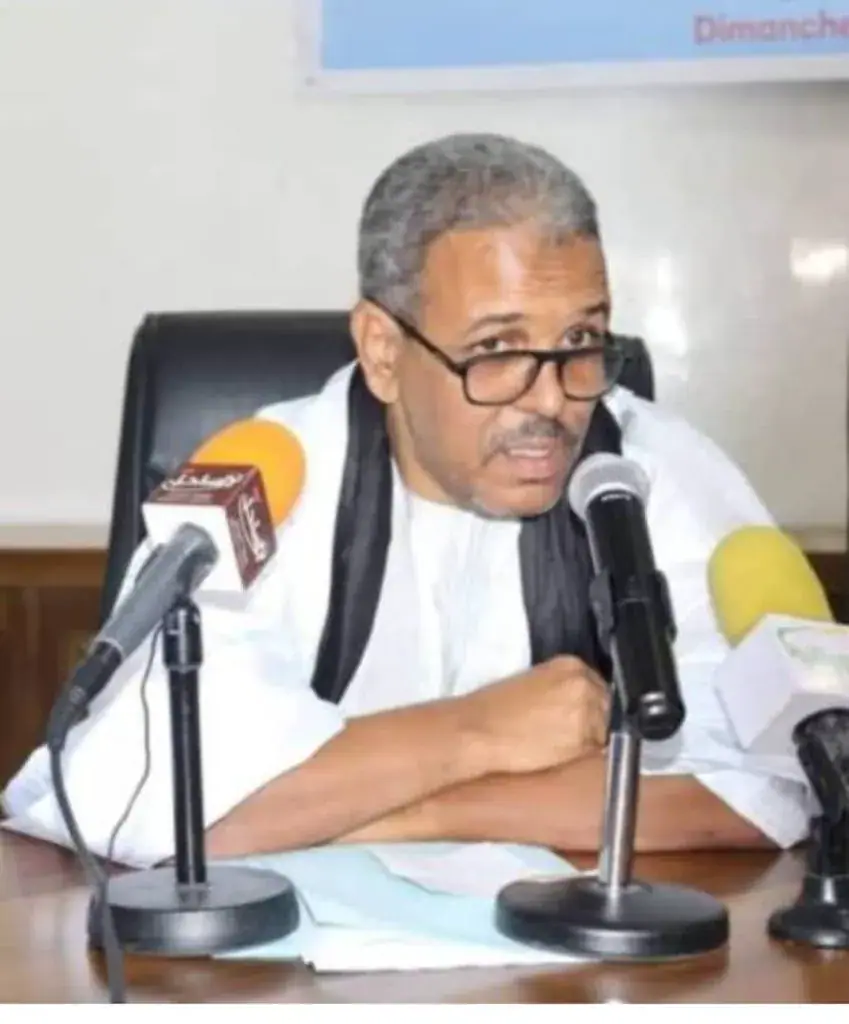
A recent statement by Dr. Ahmed Raïssouni, former president of the International Union of Muslim Scholars, has reignited a debate about Mauritania's historical existence and its relationship with Morocco. Raïssouni claimed that Mauritania never had an independent historical existence, was part of Morocco, and was created as an independent state by France. He also mentioned the role of former Mauritanian President Moktar Ould Daddah, suggesting that his marriage to a French woman contributed to the country's creation.
This is not Raïssouni's first statement on the matter; he made similar comments in August 2022, which sparked strong reactions in Mauritania. The repetition of these claims has necessitated an objective and responsible response based on historical facts, distinguishing between civilizational and cultural ties and political boundaries and sovereignty realities. Recognizing the depth of historical relations between Morocco and Mauritania does not imply denying Mauritania's societal specificity or questioning the legitimacy of its modern state.
The Mauritanian Republic, in its current legal and institutional form, took shape during the colonial period and gained independence in 1960. However, this does not mean that the land was without history, population, or political and social organizations before French colonization. The region has a long history of human settlements, centers of knowledge and commerce, and trans-Saharan networks. Various emirates, including those of Trarza, Brakna, Adrar, and Tagant, emerged and consolidated from the 17th century onwards.
These emirates were not mere tribal gatherings but entities with leaders, customs, interests, alliances, and relations with neighboring societies. Their authority and influence varied over time and circumstances, but they demonstrate that the Mauritanian space was not a political or human void awaiting colonization to enter history. The region's history predates the Hassani emirates, encompassing ancient kingdoms, human settlements, commercial establishments, and centers of knowledge that shaped the Sahara and Sahel regions.
The absence of a unified central state with the current name does not signify the absence of history, society, or political organization. History does not begin when colonial powers draw borders, and nations are not born when their states proclaim independence. The Bilad Chinguetti, or "land of Chinguetti," was associated with mahadras, educational institutions, scholar travel, manuscript copying, Maliki law, Arabic language, and intellectual exchange networks between West Africa, Morocco, and the Orient.
The influence of Chinguetti was part of a broader scientific and cultural movement, with scholars contributing to and disseminating knowledge whose works and knowledge circulated across distant regions of the Islamic world. While the name Chinguetti may not coincide with Mauritania's current political borders at all stages of history, it represents a historical and cultural reality with a distinct specificity. The interpenetration of civilizations does not abolish local particularities, and sharing language, religion, and ways of life does not automatically transform different societies into a single political entity.
Mauritanians do not need to deny their deep historical ties with Morocco to defend their national identity. The relationships between Mauritania and Morocco are ancient and multidimensional, encompassing religion, language, commerce, knowledge, Sufi paths, population movements, and social and tribal interconnections. However, recognizing these links is one thing; asserting that Mauritania was part of the Moroccan state throughout history is another. The area now known as Mauritania was never subjected to unified and permanent Moroccan political authority covering its entire current territory.
Key points
- Dr. Ahmed Raïssouni's comments have sparked debate about Mauritania's historical existence and sovereignty.
- Mauritania's history predates colonialism, with evidence of human settlements, centers of knowledge, and political organizations.
- The country's current borders and institutions were shaped during the colonial period, but its societal specificity and state legitimacy are not in question.