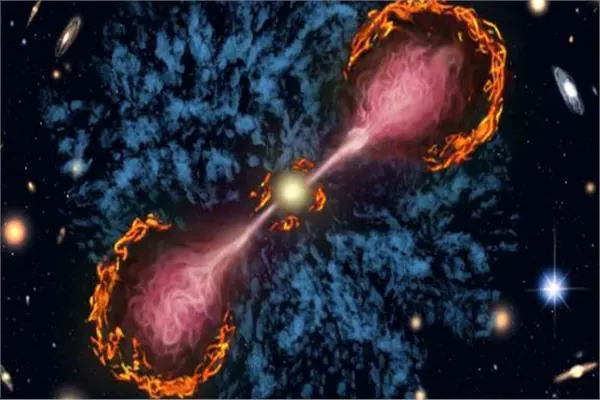
A recent study has solved a long-standing puzzle about why some galaxies stop forming new stars. Researchers found that supermassive black holes at the centers of these galaxies use powerful plasma jets to influence their surroundings, ultimately affecting the galaxy's evolution. These black holes, despite being relatively small compared to their host galaxies, have masses millions or even billions of times that of the sun.
Galaxies are surrounded by vast halos of gas and dust, known as the circumgalactic medium, which serve as the raw material for star formation. As this gas flows into the galaxy, it cools and condenses, giving birth to new stars. However, a hidden force prevents this gas from cooling and gathering, effectively stopping star formation and "killing" the galaxy over time.
The study reveals that when supermassive black holes are actively feeding, they eject powerful plasma jets that extend far beyond the galaxy's boundaries, reaching into the circumgalactic medium. This interaction creates significant disturbances in the gas balance, profoundly impacting the galaxy's growth and evolution.
Sanchayeeta Borthakur, a research scientist at the University of Arizona, noted that this discovery is a major breakthrough in understanding the relationship between black holes, their host galaxies, and the stars within them. The team's analysis of data from hundreds of active galaxies using the DESI survey and the LOFAR radio survey provided key insights.
The researchers found that the plasma jets do not randomly affect the surrounding gases; instead, their impact is most pronounced at the outer edges of the galaxies and the boundaries of the circumgalactic medium. It is at these locations that the jets release their maximum energy, influencing the galaxy's development.
Namrata Roy, a researcher at the Raman Research Institute, commented on the remarkable scale of this connection, noting that the black hole's influence extends hundreds of thousands of light-years into the depths of the galaxy's outskirts. This discovery opens up new avenues for research into the secrets of the universe's evolution and the relationship between black holes and their host galaxies.
The findings have significant implications for our understanding of galaxy evolution and the role of supermassive black holes in shaping their surroundings. As researchers continue to explore the mysteries of the universe, this study provides a crucial piece of the puzzle, shedding light on the complex interactions between black holes, galaxies, and the cosmos as a whole.
Key points
- Supermassive black holes can "kill" their host galaxies by preventing star formation through the ejection of powerful plasma jets.
- The plasma jets can extend far beyond the galaxy's boundaries, influencing the surrounding gas and dust.
- This discovery provides new insights into the relationship between black holes, their host galaxies, and the evolution of the universe.