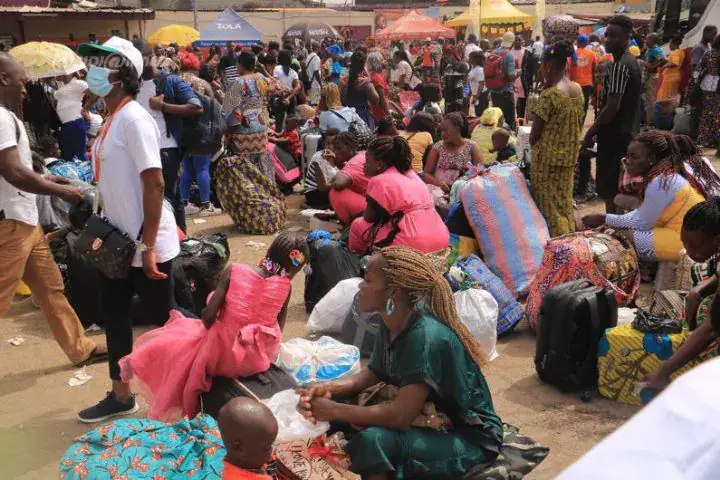
A massive influx of people is being observed in the towns of Faranah and Kissidougou as hundreds of men, women, and children return to their places of origin. They are arriving with their luggage and, in some cases, their remaining savings. The movement is particularly noticeable in the early hours of the day at the bus stations of Faranah and Kissidougou. Dozens of vehicles, including trucks, covered vehicles, personal cars, and minibuses, are discharging passengers daily.
The returnees are coming from the gold-rich areas of Siguiri, Mandiana, and Kouroussa, where clandestine gold mining activities were recently halted. Many are traveling with their families, carrying mattresses, beds, chairs, bags, and other personal belongings. The destinations vary, with some heading to Guéckédou, Macenta, N’Zérékoré, Banian, Tiro, Douako, Sandénia, or Kobikoro, while others continue their journey to Sierra Leone.
For some families, the returns bring joy as they reunite with children who had been away for months or years. However, others are worried about the financial losses incurred by their loved ones, who had invested in the mining activities. Fara Kamano, a resident of Kissidougou, welcomes the ban on clandestine gold mining, saying it will bring young people back to agricultural work. He notes that the absence of young people in the villages had led to a shortage of labor for farming.
However, not everyone shares Kamano's optimism. Ibrahima Keita, a resident of Faranah, expresses concerns about the reintegration of the returnees into their communities. He fears that without immediate economic prospects, many may struggle to adapt and fall into poverty. Keita also notes that some returnees have lost their savings, which were invested in mining activities or tontines.
The impact of the halted mining activities is not limited to those directly involved in gold extraction. Local businesses, such as Fatoumata Diallo's rice shop in Kissidougou, are also feeling the effects. Diallo reports a significant decline in sales, as the miners were a major part of her customer base. The sudden halt in mining activities has left many struggling to cope with the economic consequences.
As the returnees settle back into their communities, concerns about their reintegration and economic stability persist. While some, like Kamano, see the ban on clandestine gold mining as an opportunity for young people to return to farming, others, like Keita, worry about the challenges ahead. The Guinean government faces the task of supporting the returnees and helping them rebuild their lives.
The mass return of migrants from clandestine gold mining areas highlights the complexities of addressing informal economic activities in Guinea. The government's decision to halt the mining activities has set off a chain reaction, affecting not only the miners but also local businesses and communities. As the situation continues to unfold, it remains to be seen how the government and local authorities will address the social and economic challenges arising from this mass return.
Key points
- The halted mining activities have led to a significant influx of returnees in towns like Faranah and Kissidougou.
- Concerns persist about the reintegration and economic stability of the returnees.
- The impact of the halted mining activities is not limited to those directly involved in gold extraction, but also affects local businesses and communities.