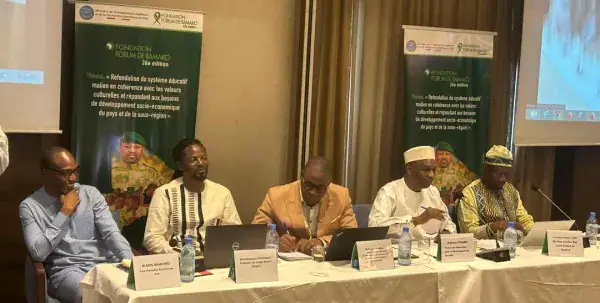
The recent Forum de Bamako brought together various stakeholders to discuss the need for education reform in Mali, focusing on aligning training programs with the country's economic and employment needs. Sidi Danioko, vice-president of Mali's Patronat, highlighted the significant gap between the number of young people entering the job market annually and the limited recruitment capacity of the public sector. He noted that 200,000 to 300,000 youths join the workforce each year, while only 20,000 to 30,000 are recruited into public service.
The informal sector plays a substantial role in Mali's economy, accounting for approximately 80% of economic activity and employment. Danioko emphasized the need for training programs that cater to the needs of businesses, particularly in emerging fields like digital technology, artificial intelligence, and robotics. This call for reform was echoed by Madi Yassa Goundiam, director of the Centre des métiers, who stressed the importance of qualified trainers with strong transmission skills and a commitment to the education community.
Adama Ouane, an expert in education for sustainable development, advocated for a holistic approach to learning that integrates school, culture, and values. He cited the benefits of dual training programs and the validation of experiential learning, while expressing concern about the fragmentation of education reforms. The Ministry of National Entrepreneurship, Employment, and Professional Training's contribution to the forum highlighted a 95.9% informal employment rate and 16.8% underutilization of the workforce in 2024.
The ministry's report also noted a mismatch between training programs and business needs, as well as insufficient financing and follow-up on professional integration. Recommendations from the forum included establishing an observatory to track the progress and integration of graduates, expanding alternating training programs, and incorporating entrepreneurial pathways into education. These discussions aim to inform the refoundation of Mali's education system, aligning it with cultural values and socio-economic development needs.
The forum featured a range of participants, including Pr Alpha Seydou Yaro, director general of the Centre national de recherche scientifique et technologique, and Souleymane Coulibaly, founder of Fanga School in Ségou. The event ran from November 5 to 7, 2026, and explored ways to revitalize Mali's education system.
Key points from the discussions include the need for education and training programs that address the specific needs of Mali's economy and job market. There is also a focus on improving the quality of trainers and promoting a more holistic approach to learning.
Ultimately, the goal of the Forum de Bamako is to create a more effective and relevant education system that prepares students for the workforce and supports the country's socio-economic development.
Key points
- Informal sector dominance
- Education and training mismatch
- Need for holistic learning approach