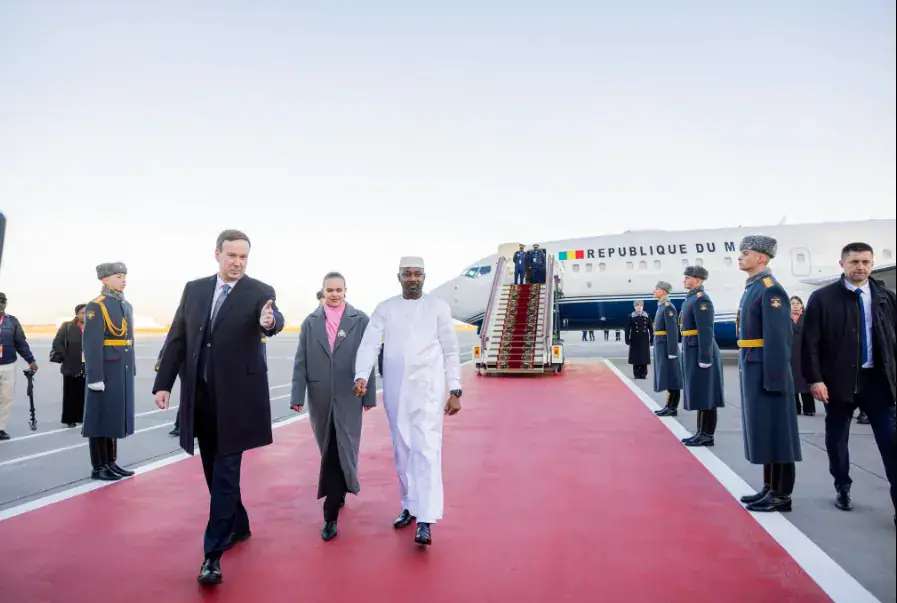
Mali's transitional president, Assimi Goïta, departed Bamako on Sunday, October 25, to attend the third Russia-Africa summit scheduled for October 28-29 in Moscow. The summit was organized at the invitation of Russian President Vladimir Poutine. According to the Malian government, Goïta's participation in the summit aims to strengthen bilateral relations between Mali and Russia. The program released on Sunday only mentioned the summit, with further details on the delegation's composition, bilateral meetings, and potential agreements to be signed to be disclosed during the stay.
Several high-ranking officials are accompanying Goïta on this trip, including the Minister of Economy and Finance, the Minister Delegate in charge of Defense and former Combatants, and the Malian Foreign Minister. This trip marks Goïta's second participation in the Russia-Africa summit, following his attendance at the second summit in St. Petersburg in July 2023. The upcoming summit provides an opportunity for Goïta to build on the discussions initiated during his previous bilateral visit to Russia in June 2025.
During the June 2025 visit, Goïta met with Poutine at the Kremlin and signed three agreements aimed at enhancing cooperation between Mali and Russia. The agreements included the establishment of an intergovernmental commission for commercial, economic, scientific, and technical cooperation. Another agreement focused on the peaceful use of atomic energy in partnership with Russia's state-owned Rosatom. A third agreement outlined a general framework for bilateral relations, particularly in the areas of politics, diplomacy, and security.
The 2025 discussions also covered various sectors, including investments, transportation, training, infrastructure, mining resources, and energy. Following the Kremlin meeting, Goïta visited Kazan in the Republic of Tatarstan, where he engaged with public officials and Russian businesses. These commitments serve as the primary framework for understanding the current visit. The summit will enable the Malian and Russian delegations to resume discussions initiated during the bilateral visit, integrating them into a multilateral setting.
Defense remains one of the primary areas of cooperation between Bamako and Moscow, with Mali receiving Russian military equipment and hosting Russian personnel involved in training and supporting national forces. The energy cooperation encompasses multiple projects at various stages of development. The agreement with Rosatom establishes a legal framework for the civil use of nuclear energy, potentially covering specialist training, medical and agricultural applications, research, and future energy infrastructure.
The intergovernmental commission is tasked with organizing economic and technical discussions, covering trade, investments, mining, energy, science, and projects involving administrations or businesses from both countries. The October 28-29 summit is expected to specify the themes on the Malian agenda. Communiqués published in Moscow will reveal the meetings held, agreements concluded, and projects with a defined timeline.
The Russia-Africa summit offers a platform for African nations to engage with Russia on various issues, including security, energy, and economic exchanges. As Mali continues to navigate its international relationships, the summit presents an opportunity for Goïta to reaffirm Mali's commitment to strengthening ties with Russia. The outcomes of the summit will likely have implications for Mali's future cooperation with Russia and other African nations.
Key points
- Mali's transitional president, Assimi Goïta, participates in the third Russia-Africa summit to strengthen bilateral relations with Russia.
- The summit aims to enhance cooperation between Russia and African nations in areas such as security, energy, and economic exchanges.
- Mali and Russia have previously signed agreements on cooperation in defense, energy, and economic sectors.