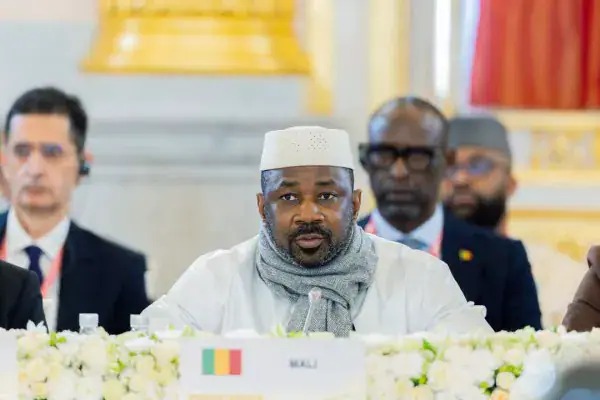
The 3rd Russia-Africa Summit, co-chaired by Russian President Vladimir Poutine and Burundian President Évariste Ndayishimiye, took place at the Grand Kremlin Palace, bringing together African leaders and government officials. Mali's President Assimi Goïta delivered a speech focusing on sovereignty, the emerging multipolar world order, and the review of Bamako-Moscow cooperation. The summit's central theme was "For Peace, Security, and Development." Goïta emphasized that the current global landscape, marked by shifting geopolitical balances and a growing aspiration for autonomy, necessitates a more equitable international order.
President Goïta stressed that Africa cannot remain a mere theater for rivalries or a reservoir of raw materials, but must assert itself as a stakeholder in global governance, free to make its own choices, alliances, and priorities. He highlighted the failure of foreign military interventions in the Sahel region over the past decade, which has only led to the expansion of terrorism. As a result, Mali has opted to rely on its own resources to defend its territory and protect its citizens, leading to the strengthening of the Malian Armed Forces (FAMa) and the gradual restoration of central authority.
The Malian President also addressed the issue of information warfare, condemning external attempts to destabilize the country and discredit its government. He welcomed the launch of the Alliance of Sahel States' (AES) television network, aimed at countering foreign-backed disinformation campaigns. Goïta then outlined his country's internal agenda, which includes a new constitution based on state sovereignty, respect for the people's choices, and the protection of vital interests. Economically, Mali is focused on promoting public morality, administrative reform, and an endogenous model that prioritizes the valorization of national wealth and energy autonomy.
President Goïta highlighted the importance of human capital, declaring 2026-2027 as the Year of Education and Culture. He also discussed the Confederation of Sahel States, established with Burkina Faso and Niger, which aims to enhance cooperation in defense, diplomacy, and development. The Confederation seeks to facilitate human and commercial exchanges, develop energy and transportation infrastructure, and establish a future investment bank. On bilateral relations with Russia, Goïta described the partnership as loyal, balanced, and responsive to the needs of the Malian people.
The Malian President cited several examples of successful cooperation with Russia, including military support, food aid, and infrastructure development. Russia has provided significant assistance, such as 30,000 tons of wheat, 117 tons of oil, and 30,000 tons of fertilizer. Additionally, Russia has supported Mali's energy sector, with projects like a new refinery and a photovoltaic power plant. The two countries have also strengthened their educational ties, with Russia offering 300 scholarships annually and training over 10,000 Malian civilians and military personnel.
In his opening speech, President Poutine positioned Russia as a natural ally for Africa in the quest for a multipolar world order, free from double standards. He highlighted the growth in bilateral trade, which exceeded $27 billion last year, a 50% increase since the previous summit. The Russian leader also noted the easing of customs barriers, allowing 32 African countries to export goods to Russia duty-free. Furthermore, the use of national currencies in trade between Russia and Africa has reduced the risk of external financial pressures.
Burundian President Évariste Ndayishimiye, speaking on behalf of the African Union, emphasized the need for strategic investments and mutually beneficial partnerships with Russia. He stressed that Africa seeks not charity but rather pragmatic economic cooperation that can help the continent transform its resources, modernize its agriculture, and create local value-added industries. The African leaders' participation in the summit reflects their desire to diversify partnerships and strengthen cooperation with Russia, based on sovereign equality and mutual respect.
Key points
- President Assimi Goïta calls for a decolonized partnership with Russia, emphasizing Mali's sovereignty and the need for a multipolar world order.
- The 3rd Russia-Africa Summit aims to strengthen cooperation between Russia and African countries in areas such as peace, security, and development.
- Mali and Russia have strengthened their bilateral ties, with cooperation in defense, energy, and education sectors.