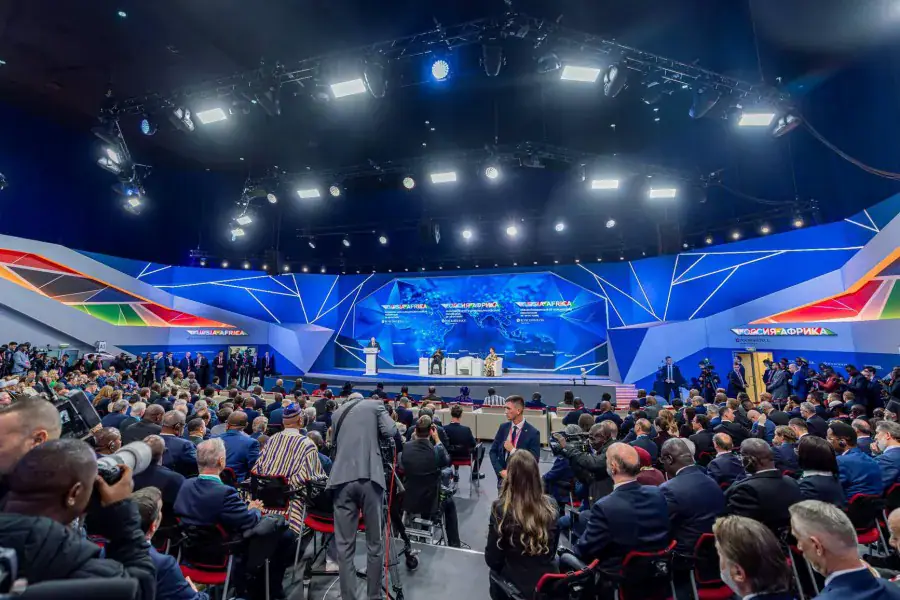
The recent Russia-Africa summit in Moscow, co-chaired by Russian President Vladimir Poutine and Évariste Ndayishimiye, president of the African Union, brought together 48 African nations. The summit aimed to strengthen security and economic partnerships between Russia and Africa. Key outcomes included the adoption of three major documents: the Moscow Declaration, a statement on the civil use of artificial intelligence, and the 2027-2029 Action Plan. These documents outlined areas of cooperation, including multipolarity, UN Security Council reform, and financial system restructuring.
The Moscow Declaration, comprising 101 points, solidified the convergence of views on global issues. The statement on artificial intelligence set the stage for technological cooperation in areas like agriculture, healthcare, and public administration. The 2027-2029 Action Plan established evaluation mechanisms and binding calendars to ensure tangible progress. Mali's President Assimi Goïta participated in the summit, signing significant cooperation agreements. His engagement resulted in notable advancements in Mali's extractive industries, including two major agreements with Zarubezhgeologia.
The agreements with Zarubezhgeologia will facilitate the creation of a digital geological map of over half of Mali's territory and the deployment of a centralized mineral information system. These deals are crucial for Mali's extractive industries, particularly for gold and lithium. Additionally, cooperation instruments were signed in epidemiological surveillance, anti-money laundering efforts, and the expansion of civilian and military scholarships. These outcomes demonstrate the potential for strengthened Russia-Mali cooperation.
Some significant projects discussed during the summit build upon previous agreements. For instance, the equipment deal with KAMAZ involves the establishment of a maintenance center in Sénou and a future assembly unit. Progress on the gold refinery project and the Sanankoroba solar power plant was also addressed at the highest level. These developments reflect the ongoing cooperation between Russia and Mali.
A notable institutional development was the signing of a memorandum of understanding between the Alliance of Sahel States' (AES) Investment Bank and the Russian bank VEB.RF. This partnership aims to implement a major project in energy or transportation within 12 months. The AES Investment Bank's first major international partnership poses an operational challenge, given the historically limited Russian direct investments in Africa.
President Assimi Goïta's visit to Moscow has reinforced Mali's diplomatic status within the AES alliance. Upon his return, he conveyed the summit's outcomes to his peers in Niamey and Ouagadougou. The success of the Moscow summit will be evaluated based on the tangible implementation of projects, such as the Sanankoroba power plant, the materialization of confederal financing, and the commencement of cartographic work.
The true test of the summit's success lies in the actualization of these agreements. The implementation of these projects will demonstrate the effectiveness of Mali's diplomatic efforts and its cooperation with Russia. Key projects, such as the gold refinery and solar power plant, are expected to drive progress. The Russia-Africa summit has set a foundation for enhanced cooperation, but its impact will be measured by the concrete outcomes.
Key points
- President Assimi Goïta secured significant cooperation agreements in extractive industries and other sectors during the Russia-Africa summit.
- The summit resulted in the adoption of key documents, including the Moscow Declaration and the 2027-2029 Action Plan.
- The success of the summit will be evaluated based on the implementation of tangible projects in Mali.
Reporting sources
- Sommet Russie-Afrique : L'heure du bilan... · Maliweb.net