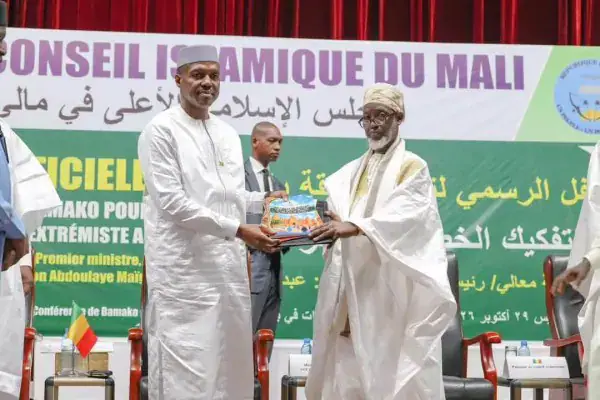
In a significant move to combat extremist ideologies, Mali's government and Islamic leaders gathered at the Bamako International Conference Center on October 29, 2026, to launch the 'Document of Bamako'. This comprehensive guide aims to promote a peaceful and tolerant interpretation of Islam, countering the manipulation of sacred texts by extremist groups. The document, developed by the High Islamic Council of Mali (HCIM), was presented as a crucial tool for promoting national cohesion and unity.
The ceremony, attended by government officials, prominent Islamic scholars, traditional leaders, and civil society members, was marked by a sense of unity and shared responsibility. The event began with the recitation of Quranic verses and a welcome address by the mayor of Bamako's commune III. The first vice-president of the HCIM, Cheick Ibrahim Kontao, highlighted the spiritual and social significance of the document, emphasizing the need for the Muslim community and other stakeholders to adopt this guide to counter sectarian deviations.
Ismaël Diakité, speaking on behalf of Islamic scholars and religious leaders, stressed the importance of unity in eradicating hate speech and promoting social cohesion. He noted that the preservation of social peace was a collective responsibility and that the 'Document of Bamako' provided a vital framework for guiding believers, educating young generations, and preventing attempts to divide society in the name of religion. The document, comprising 73 pages, was officially handed over to the Malian Prime Minister, General Abdoulaye Maïga.
Prime Minister Maïga welcomed the initiative, praising the HCIM and all parties involved in drafting the document. He emphasized that the collective effort was essential in countering hate speech and extremism, which threatened peace and social cohesion. The Prime Minister recalled that the launch of the document reaffirmed a shared commitment to national unity and social cohesion, highlighting the crucial role of religious leaders in promoting mutual respect, fraternity, and peaceful coexistence.
General Maïga also acknowledged the complex security and social challenges facing Mali, including the threat of armed violence, disinformation, and the instrumentalization of religion. He paid tribute to the Defense and Security Forces, commending their dedication and sacrifices in defending territorial integrity and protecting citizens. The Prime Minister stressed that a sustainable peace required a comprehensive strategy combining prevention, awareness, interfaith dialogue, and cooperation with local populations.
The Prime Minister urged religious organizations, public institutions, and civil society to actively engage in disseminating, adopting, and implementing the recommendations outlined in the 'Document of Bamako'. He emphasized that preserving peace was a shared responsibility, requiring the rejection of prejudice, the refusal of amalgamations, and the protection of young people from manipulation. The Prime Minister encouraged citizens to integrate the document's principles of tolerance, respect, and dialogue into their daily lives.
The launch of the 'Document of Bamako' marks a significant step towards promoting national unity and combating extremist narratives in Mali. The government's commitment to working with Islamic leaders and civil society to promote tolerance and coexistence has been welcomed by many. As the country continues to face complex security challenges, the 'Document of Bamako' is seen as a vital tool for fostering a culture of peace, understanding, and mutual respect.
Key points
- The 'Document of Bamako' aims to promote a peaceful and tolerant interpretation of Islam, countering extremist ideologies in Mali.