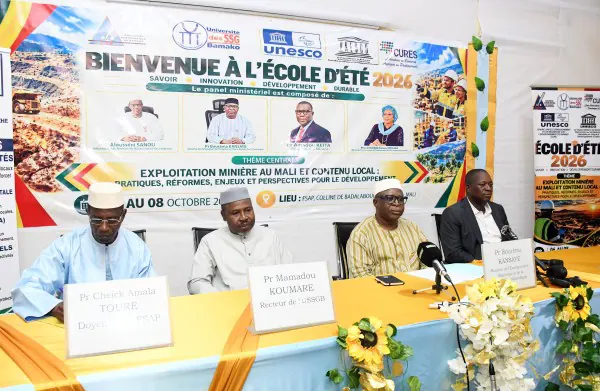
The University of Kurukanfuga in Bamako, in partnership with the University of Social Sciences and Management, has officially launched the first edition of its summer school dedicated to the theme "Mining Exploitation in Mali and Local Content: Practices, Reforms, Issues, and Perspectives for Development". The opening ceremony took place at the Pedagogical Block of the Faculty of Administrative and Political Sciences. The event was attended by the Minister of Higher Education and Scientific Research, Professor Bouréma Kansaye, and representatives from various ministerial departments.
The summer school, which will last for three days, targets experts, teachers, students, and doctoral students. The event aims to address the recent reforms in the mining sector, including the adoption of a new mining code and a law on local content. According to the Rector of the University of Kurukanfuga, Professor Paul Traoré, these reforms have already started to yield results, with a significant increase in mining revenues. He emphasized the importance of universities playing an active role in these transformations.
Professor Traoré also announced the creation of a master's program in mining rights, investment rights, and natural resource governance, which is expected to start in the 2026-2027 academic year. The program aims to train jurists specialized in negotiating mining contracts, investment rights, and natural resource governance policies. The Rector expressed his hope that the summer school will become an annual event.
Minister Bouréma Kansaye recalled the provisions of the law on local content, which prioritizes the use of national competencies, limits expatriate personnel to 10%, and requires at least 35% of foreign company shares to be held by Malian partners. He warned that the law will remain ineffective if educational institutions fail to train the required technical elite. The Minister praised the recent creation of schools of mining and petroleum and the deployment of excellence poles in mining engineering.
Minister Kansaye emphasized the need for an interdisciplinary approach, suggesting that economists should be involved in the future master's program in mining rights to train cadres capable of analyzing sectoral financial flows, fiscal traceability, and local development fund management. He also stressed the importance of environmental protection, ensuring that local content guarantees ecosystem preservation through site rehabilitation programs, clean treatments, and biodiversity preservation.
The Minister called on sector companies to open their doors to students for immersion internships, finance research, and solicit national laboratories for geological and environmental analyses. He stated that connecting universities to market realities ensures immediate and sustainable professional insertion for graduates. The summer school is seen as a significant step towards reinforced national appropriation of the mining sector.
The event is expected to contribute to the development of Mali's mining sector and promote local content. The summer school will provide a platform for experts, teachers, and students to discuss practices, reforms, issues, and perspectives for development. The Malian government has been working to strengthen its control over the mining sector and increase local participation.
Key points
- The summer school aims to train professionals in mining rights, investment rights, and natural resource governance.
- The event targets experts, teachers, students, and doctoral students.
- The Malian government has adopted a new mining code and a law on local content to increase local participation in the mining sector.