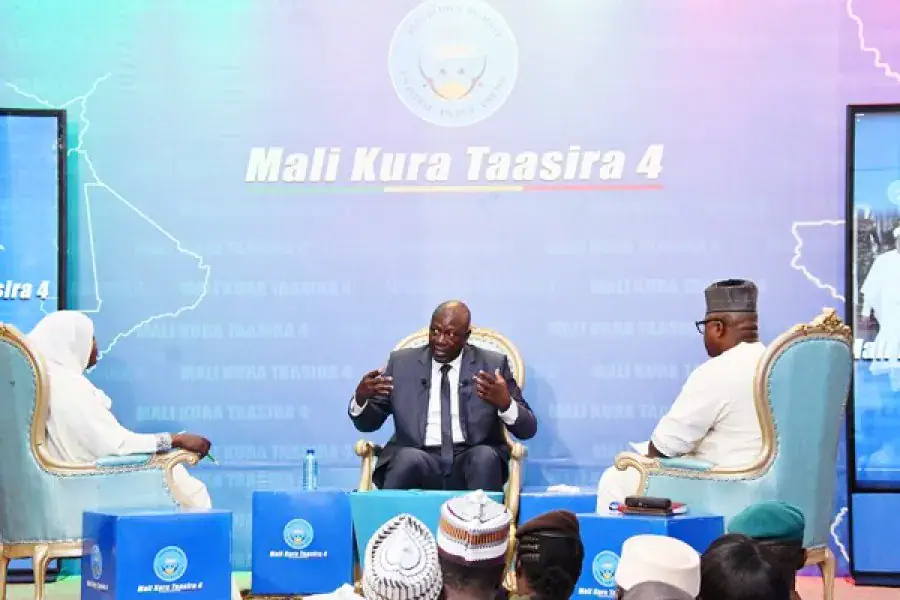
The Malian government recently aired a series of TV specials, Mali Kura Taasira Numero 4, from November 9 to 14, 2026, aimed at promoting accountability and transparency. In this series, five ministers appeared on separate evenings to defend the actions of their respective departments. The ministers who participated in the series included Dr. Mahamadou Oumar Koné, Minister of Religious Affairs, Dr. Amadou Sy Savané, Minister of National Education, Pr Bouréma Kansaye, Minister of Higher Education and Scientific Research, and others.
Dr. Mahamadou Oumar Koné, Minister of Religious Affairs, was the first to appear on November 9, 2026. He emphasized the importance of religion in maintaining national stability and highlighted the ongoing dialogue between his ministry and various religious denominations. Koné cited a meeting held on September 28, 2026, at the CICB in Bamako, which brought together representatives from the Islamic High Council, the Episcopal Conference, and Protestant Evangelical Churches. He stressed the need for interfaith dialogue and the prevention of violent extremism through youth sensitization in places of worship.
On November 10, 2026, Dr. Amadou Sy Savané, Minister of National Education, presented his case, focusing on the significant investments made by the state in the education sector. He mentioned the rehabilitation of over 2,230 classrooms, the construction of 1,104 new classrooms, and the acquisition of 67,000 desks. Savané also claimed that the credibility of exams had been restored through measures against cheating and fraud. However, his assertions were met with skepticism from citizens, who pointed out pressing issues such as the lack of teachers, the precarious situation of community teachers, and regional disparities in education quality.
Pr Bouréma Kansaye, Minister of Higher Education and Scientific Research, appeared on November 11, 2026, and defended the decentralization of university education. He highlighted the development of the University of Kayes and the rehabilitation of university campuses and infrastructure in various regions. Kansaye also emphasized the digitalization of student registration and scholarship payments. Nevertheless, students countered that persistent delays in scholarship payments and the high cost of living had not been adequately addressed.
The TV series provided a platform for citizens to express their concerns and hold ministers accountable for their actions. While some ministers presented data-driven arguments, others faced criticism for not adequately addressing the concerns of citizens. The series demonstrated the government's efforts to promote transparency and accountability, but also highlighted the challenges in bridging the gap between government actions and citizens' experiences.
The Mali Kura Taasira Numero 4 series concluded after five episodes, having provided a unique opportunity for citizens to engage with government ministers. The series demonstrated the importance of open dialogue and accountability in governance. As the Malian government continues to implement its policies, it is likely that citizens will continue to demand greater transparency and accountability from their leaders.
Key issues raised during the series included the need for improved education infrastructure, timely scholarship payments, and effective interfaith dialogue. The government's efforts to address these concerns will be closely watched by citizens, who expect tangible results from the policies and programs implemented by their leaders.
Key points
- The Malian government aired a TV series, Mali Kura Taasira Numero 4, featuring five ministers defending their actions and addressing public concerns.
- Ministers presented data-driven arguments, but faced criticism for not adequately addressing citizens' concerns.
- The series highlighted the importance of transparency and accountability in governance and the need for the government to address pressing issues affecting citizens.