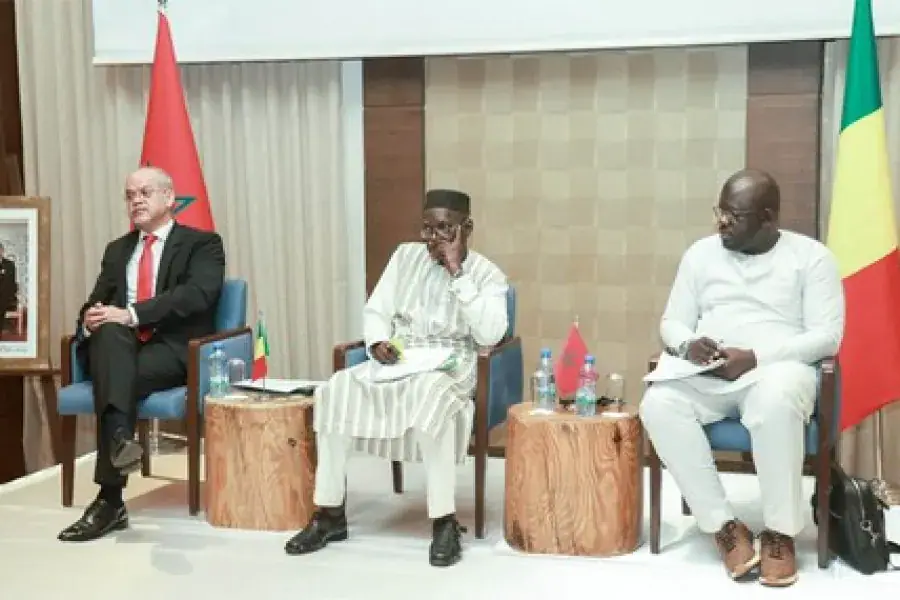
The Embassy of the Kingdom of Morocco in Mali recently celebrated the first anniversary of Morocco's Unity Day with a roundtable discussion at the Radisson Collection Hotel. The event, led by Moroccan Ambassador to Mali Driss Isbayène, brought together notable figures such as writer and historian Daouda Tékété and Souleymane Satigui Sidibé, Executive Director of the Sahelian Research and Analysis Institute for Conflict Transformation. The discussion highlighted Morocco's diplomatic efforts, historical ties between Mali and Morocco, and peace and security challenges in the Sahel region.
Ambassador Isbayène explained the history behind Morocco's Unity Day, which commemorates the adoption of UN Security Council Resolution 2797 on the Moroccan Sahara on October 31, 2025. He noted that King Mohammed VI had instructed that this day be celebrated as a national holiday, known as "Aid Al Wahda" (Unity Day), to emphasize national unity and territorial integrity. Isbayène also highlighted Morocco's Initiative for Autonomy in the Sahara region, presented in 2007, which he described as a compromise solution that guarantees democratic and autonomous management of regional affairs.
The Moroccan autonomy initiative, according to Isbayène, has been endorsed by the UN Security Council as the basis for negotiations to resolve the Sahara conflict. He emphasized that the initiative provides for a transitional council, an economic and social council, and broad powers in administration, jurisdiction, and local police. The initiative also allows for dialogue and cooperation with foreign regional entities and provides financial resources. Isbayène concluded that the autonomy project is a fundamental factor for peace and security in Morocco and the Sahel region.
Historian and writer Daouda Tékété discussed the historical ties between Mali and Morocco, which date back to the 11th century. He noted that these ties have strengthened over time, particularly in the 1960s with the creation of the Casablanca Group, a bloc of progressive and anti-colonial African countries. Tékété also recalled the visit of King Mohammed VI to Mali in 2014 and the recent withdrawal of Mali's recognition of the Sahrawi Arab Democratic Republic.
The roundtable discussion also touched on economic relations between Mali and Morocco, with many Moroccan companies operating in various sectors in Mali. The two countries have also cooperated in education, with Morocco providing scholarships to Malian students and training for Malian imams.
Souleymane Satigui Sidibé discussed the themes of territorial integrity, peace, and security in the Sahel region. He noted that Morocco defends its sovereignty over the Sahara and presents the autonomy initiative as a compromise solution to the conflict.
The celebration of Morocco's Unity Day in Mali highlights the strong ties between the two countries and their shared commitment to peace and stability in the region. The event provided a platform for discussion and cooperation on key issues affecting the Sahel region.
Key points
- Morocco's autonomy initiative for the Sahara region has been endorsed by the UN Security Council as the basis for negotiations to resolve the conflict.
Reporting sources
- Célébration du 1er anniversaire de la... · Maliweb.net