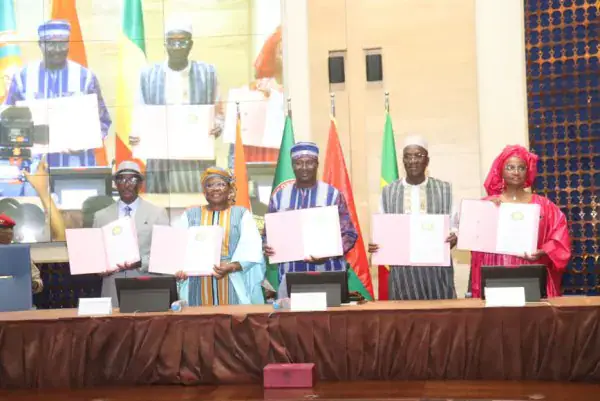
The first ministerial session of the Alliance of Sahel States (AES) education forum concluded in Niamey, with the adoption of foundational texts that define the vision, missions, objectives, and priority areas for educational cooperation. The texts were adopted by the ministers of education from Mali, Burkina Faso, and Niger, who also agreed on the establishment of a technical committee to monitor cooperation. The committee will oversee the implementation of the agreed-upon decisions.
The closing ceremony of the session was presided over by Burkinabé Minister of Basic Education, Literacy, and Promotion of National Languages, Jacques Sosthène Dingara, who is also the president of the Conference. In his closing speech, Dingara praised the results of the session, highlighting that the meeting marks an important step in concretizing educational cooperation within the AES. He emphasized that education and training are essential levers for sovereignty, economic transformation, and endogenous development.
The adopted framework documents outline several priority areas for cooperation, including the progressive harmonization of curricula, promotion of national languages, strengthening of teacher training, access to inclusive and quality education, and development of technical and vocational training. The ministers also adopted the internal regulations of the Conference and decided to establish a national focal point for each country.
The ministers formulated several recommendations, including the establishment of an experts' committee for the Conference, formalization of the technical secretariat, and creation of a shared digital platform. They agreed to develop a program of activities for 2027 and maintain permanent consultation to monitor adopted decisions. The next ordinary session will be held in Burkina Faso at a later date.
The ministers reaffirmed their commitment to strengthening solidarity among the three states, promoting educational systems adapted to Sahelian realities, and giving special attention to girls' education, vulnerable persons, and children affected by security and humanitarian crises. They also agreed to prioritize the education of girls and vulnerable populations.
The agreed-upon decisions aim to build a sovereign and resilient educational system in the AES countries. The ministers emphasized that the construction of an integrated educational and training space should respect national specificities while promoting gradual convergence of policies, norms, and qualification systems.
The implementation of the agreed-upon decisions is expected to enhance cooperation and coordination among the AES countries in the education sector. The ministers' commitment to strengthening educational systems is seen as a crucial step towards achieving sustainable development and sovereignty in the region.
Key points
- Ministers adopt foundational texts for educational cooperation in Niamey.
- Cooperation to focus on harmonizing curricula, promoting national languages, and strengthening teacher training.
- Next ordinary session to be held in Burkina Faso at a later date.