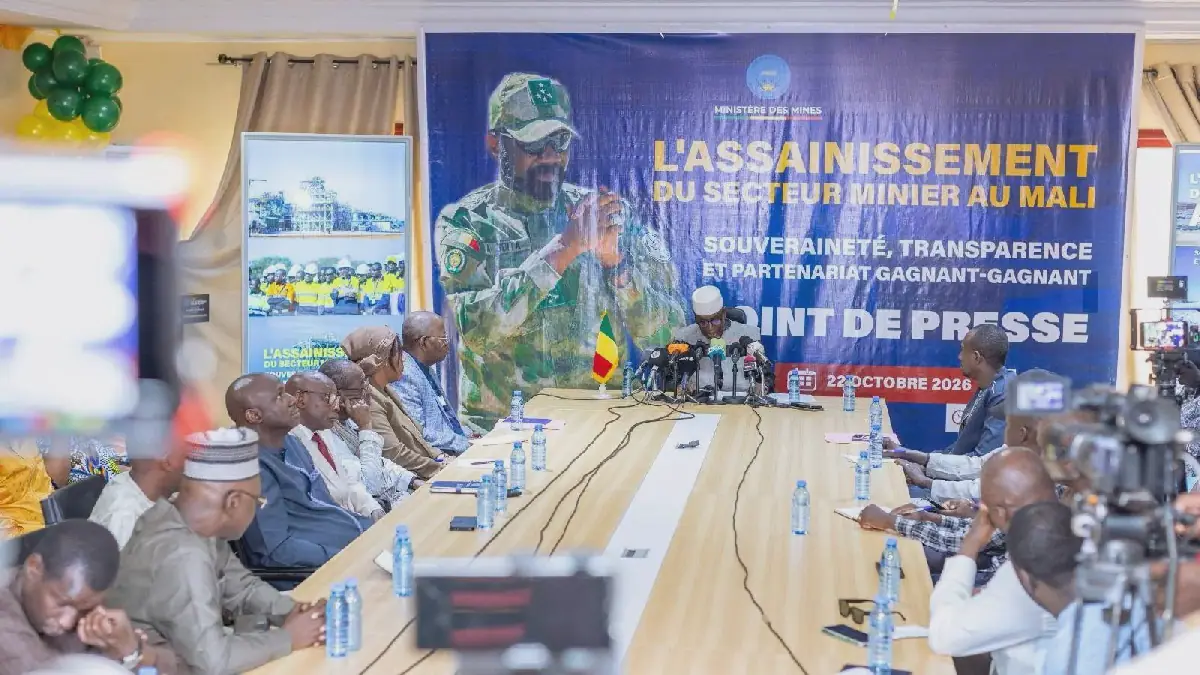
Mali's Minister of Mines, Pr Amadou Keïta, unveiled key reforms aimed at revitalizing the country's mining sector on October 22, 2026. The reforms focus on enhancing oversight, increasing transparency, and fostering partnerships that benefit the nation. These changes are part of a broader effort to optimize the sector's contributions to the Malian economy. The minister emphasized the importance of these measures in ensuring the sector's sustainability and growth.
A new mining code and local content law, effective since 2023, have been instrumental in these reforms. The legislation allows Malian interests to hold up to 35% of the capital in mining projects. This move is expected to increase local participation and benefits from the sector. Additionally, an audit of mining companies has led to the recovery of 761 billion FCFA in arrears, highlighting the government's commitment to enforcing compliance and maximizing revenue.
The Malian government has also taken steps to sanitize the mining cadastre. Since November 2022, a freeze on new title requests has resulted in the cancellation of over 90 exploration permits by October 2025. In August and September 2026, 24 gold and lithium exploration permits were renewed, but these renewals do not imply favoritism or exploitation authorization. This process aims to ensure that only serious and compliant operators are active in the sector.
Despite a decline in industrial gold production to 42.2 tonnes in 2025 from 54.8 tonnes in 2024, largely due to reduced output at Loulo-Gounkoto, the sector shows signs of recovery. Gold exports reached 2,750 billion FCFA, and mining companies paid 940 billion FCFA to the state. The first half of 2026 saw a 30% increase in production to 23.5 tonnes, with an annual target of 43.2 tonnes. The lithium sector is also expected to grow, with Goulamina and Bougouni mines projected to boost national capacity to 590,000 tonnes of concentrate by 2026.
The mining sector's contributions to local development are significant. The Mining Development Fund mobilized 18.4 billion FCFA in 2025 for distribution to 819 communes, with a focus on mining communities. Another fund collected 109.14 billion FCFA for infrastructure projects, including roads, railways, and energy. These initiatives underscore the government's commitment to ensuring that mining activities benefit local populations and contribute to national development.
Minister Keïta also announced enhanced efforts to combat illegal gold mining, which has resulted in lost revenue, environmental degradation, mercury and cyanide pollution, and fatal accidents. The Special Mining Brigade will lead this crackdown. He clarified that "artisanal mechanized exploitation" is not recognized under the Mining Code, emphasizing the need for formalized and regulated mining activities.
Looking forward, the government plans to establish a School of Mines and Petroleum, as well as a Mineral Resources Research Agency. These institutions will help build local capacity and knowledge, supporting the sector's long-term sustainability. The minister reassured compliant companies that they have nothing to fear, stressing that the Mining Code will be applied universally, without exception.
Key points
- Mali introduces new mining code and local content law to increase local participation and revenue.
- The government recovers 761 billion FCFA in arrears from mining companies through audits.
- Industrial gold production sees a 30% increase in the first half of 2026, with an annual target of 43.2 tonnes.