The Indian Embassy in Mali recently celebrated the success of the Indian Technical and Economic Cooperation (Itec) program, a flagship initiative aimed at capacity building and technical assistance for developing countries. Created in 1964, Itec has become one of the oldest and most enduring international capacity-building mechanisms, covering over 160 partner countries across Africa, Asia, Eastern Europe, Latin America, the Caribbean, and the Pacific Islands.
Since its inception, Itec has trained over 200,000 officials, entrepreneurs, and professionals, including around 500 from Mali. The program is fully funded by the Indian government and offers a range of professional courses, with 70 scholarships available annually for Malian students. Indian Ambassador Dr. N. Nandakumar highlighted the significance of Itec, stating that it embodies India's commitment to partnership, capacity building, and shared growth with developing countries.
The Itec program focuses on providing technical assistance and training to support the development of partner countries. Ambassador Nandakumar emphasized that India's own development experience has informed its approach to capacity building, with a focus on technical education and skills development. He noted that despite India's own development challenges after independence, the country has prioritized cooperation and solidarity with partner countries through initiatives like Itec.
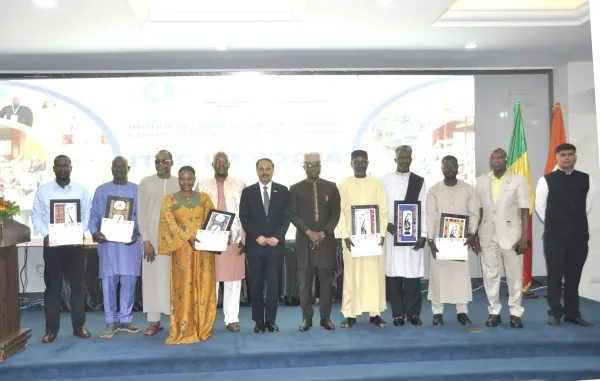
The program has contributed significantly to Mali's development, with many beneficiaries returning to their home country to apply their skills and knowledge. One Malian beneficiary, who learned paper transformation techniques in India, now practices his new profession in Mali. The celebration also recognized Malian recipients of the program who have made notable contributions to their country's development.
Itec is part of India's broader South-South cooperation efforts, aiming to promote mutual growth and solidarity among developing countries. Ambassador Nandakumar described Itec as an instrument for mutual enrichment and fraternal solidarity, rather than simply a form of aid. The program reflects India's conviction that development is achieved through collaboration, not competition.
The Itec program has evolved over the years, with an increasing range of professional courses and training quotas available to Mali. The Indian government has consistently supported the program, which has become a cornerstone of India-Mali cooperation. As India continues to prioritize capacity building and technical assistance, the Itec program is likely to remain a key component of its development cooperation efforts.
The celebration of Itec's success in Mali highlights the strong bilateral ties between India and Mali, with both countries committed to deepening their cooperation in areas such as education, technical assistance, and economic development. As the program continues to benefit Malian professionals, it also underscores India's role as a partner in Mali's development journey.
Key points
- The Itec program has trained over 200,000 officials, entrepreneurs, and professionals worldwide, including around 500 from Mali.