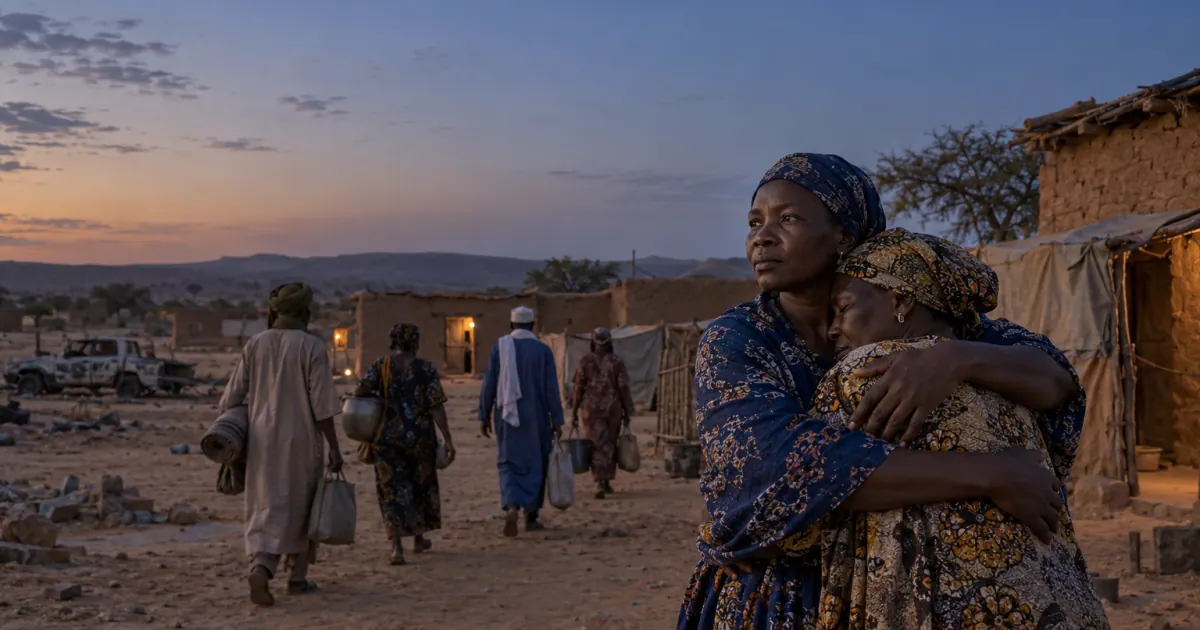
An investigation by Jeune Afrique and Bellingcat has revealed that Mali's military, with the help of Russian allies, has killed 731 civilians in 199 drone strikes over the past three years. The strikes, which began in 2023, have been carried out using drones provided by Turkey and Russia. The investigation used geolocated images, satellite data, and eyewitness accounts to verify the strikes and their civilian casualties.
The investigation found that the Malian military and its partners have struggled to accurately identify targets, leading to a significant number of civilian casualties. In many cases, the presence of a vehicle in an area controlled by rebels was enough to make its occupants a target. This has led to accusations of "guilt by location," where individuals are targeted based on their location or activity rather than their affiliation with armed groups.
One notable incident occurred on July 8, 2025, in the town of Zouéra, where the Malian military claimed to have destroyed a vehicle used by armed groups. However, geolocated images showed that the explosion also damaged a nearby building, killing four civilians, including three young girls. Médecins sans frontières reported that five others were injured and taken to a local health center.
The investigation highlighted concerns about the military's targeting process, particularly the lack of transparency and accountability. The use of drones has raised questions about the ability of the Malian military and its partners to accurately identify targets and minimize civilian casualties. The Positive Identification and Collateral Damage Estimation procedures, essential steps in the targeting process, appear to have been inadequate or ignored in some cases.
The Malian military has acquired several types of drones, including the Turkish Bayraktar TB2 and Akıncı models, and Russian kamikaze drones. The Akıncı drones, which have a longer range and can carry more munitions, were acquired in August 2024 in a $210 million deal. However, the source of the funds and the involvement of the director of the National Security Agency in the deal have raised questions about accountability and transparency.
The involvement of multiple actors, including the Malian military, Turkish and Russian trainers, and private military companies, has created a complex and opaque chain of responsibility. The investigation has highlighted the need for greater transparency and accountability in the use of drones and the targeting process. The Malian military has not provided a substantive response to the investigation's findings.
The use of drones in Mali has significant implications for civilian populations and the conflict dynamics in the region. The investigation's findings have raised concerns about the military's ability to balance security concerns with the need to protect civilians. The international community has called for greater accountability and transparency in the use of drones and military operations in Mali.
Key points
- 731 civilians have been killed in 199 drone strikes carried out by the Malian military and its partners over the past three years.
- The investigation found evidence of "guilt by location," where individuals are targeted based on their location or activity rather than their affiliation with armed groups.
- The Malian military has acquired several types of drones, including Turkish and Russian models, which have been used in the conflict.