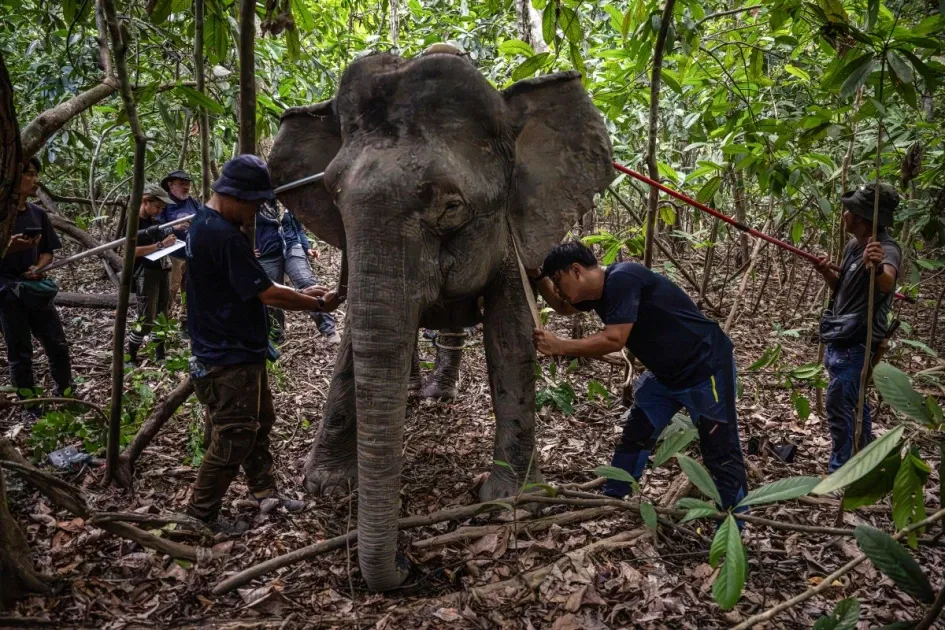
In Sabah’s Borneo jungle, conservationist Farina Othman and her team have been working tirelessly to safeguard the dwindling population of Bornean elephants. Recently, they tranquilized a wild elephant, fitted a tracking collar, and collected blood samples before retreating to allow the animal to recover. This effort is part of Othman’s plan to create safe movement corridors through fragmented forest and oil-palm plantations, reducing human-elephant conflict in the region.
The Bornean elephant population is critically endangered, with only about 1,000 individuals remaining in the wild. Roughly 160 of these elephants reside in the Lower Kinabatangan floodplain, an area that has been reduced to half its original elephant-friendly space. This habitat loss has led to increased conflict between elephants and local communities, as the animals stray onto private land or villages in search of food and shelter.
When elephants encroach on human settlements, clashes are common. A recent incident involving a herd of 20 elephants caused panic in three villages, prompting calls for stronger deterrents such as upgraded electric fencing. Local residents often feel unsafe, especially with large bulls, some weighing up to five tonnes, able to bypass fences to feed on palm trees, heightening tensions between humans and elephants.
To address this issue, Othman’s group, Seratu Aatai, runs community outreach programs in plantation schools, distributes informational pamphlets, and appoints “community wildlife guardians” to help steer elephants away from homes without harm. These efforts have shown positive results, with local homestay owner Firah Kazenn noting that villagers now know how to safely guide elephants, reducing the loss of animals to conflict.
Othman aims to persuade seven nearby oil-palm estates to set aside land for elephant corridors, arguing that the presence of wildlife is an ecological reality rather than a disturbance. However, industry specialists warn that tight profit margins make plantation owners reluctant to allocate land for conservation purposes. They call for greater recognition and financial aid from Western palm-oil buyers to support sustainable practices.
The Malaysian Palm Oil Green Conservation Foundation emphasizes the need for win-win solutions that benefit both planters and wildlife. This highlights the challenge of balancing economic and conservation goals in the region. By working together, stakeholders hope to find a solution that protects the Bornean elephant population while also supporting the local economy.
The efforts of Farina Othman and her team have shown promising results, and their work serves as a model for conservation efforts in other regions. Key to their success is the collaboration between conservationists, local communities, and industry stakeholders. By continuing to work together, it is possible to safeguard the Bornean elephant population and ensure the long-term sustainability of the region’s ecosystem.
Key points
- Conservationist Farina Othman is using tracking collars and community outreach to reduce human-elephant conflict in Sabah’s Kinabatangan region.
- Only about 1,000 Bornean elephants remain in the wild, with roughly 160 residing in the Lower Kinabatangan floodplain.
- Othman aims to persuade seven nearby oil-palm estates to set aside land for elephant corridors to create safe movement routes for the endangered species.