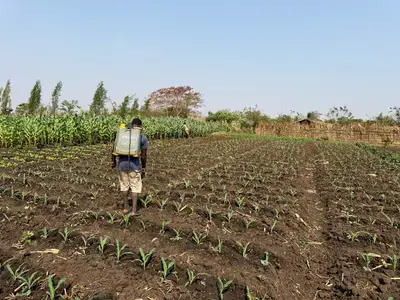
Malawi has committed $1 million to a national seed investment plan aimed at boosting agricultural productivity. However, conflicting reports on who is funding the plan have raised questions about its implementation and accountability. The Mail & Guardian reported that the plan was publicly funded, while the Malawi Broadcasting Corporation stated that the Alliance for a Green Revolution in Africa (Agra) had promised $1 million to support its implementation.
The seed investment plan is part of Malawi's efforts to strengthen its agricultural sector. The country has established a formal framework, including the 2018 National Seed Policy and the Seed Act of 2022. The policy seeks to improve quality assurance, certification, and domestic seed industry growth. The Seed Act established a regulatory authority and aligned parts of the system with regional economic blocs.
Despite these efforts, Malawi's agricultural sector faces significant challenges. The African Union's 2025 Seed Sector Performance Index gave 50 countries an average score of 4.63 out of 10, with the use of quality commercial seed scoring 3.06. Malawi's individual score was not disclosed. The country's national strategy identifies limited government support for variety development, capacity gaps in certification, and weak agricultural extension services as major challenges.
The seed debate is not only about germination or the release of new varieties, but also about whether productivity policy reduces the economic and climatic risks that separate harvests from meals. The Alliance for Food Sovereignty in Africa (AFSA) challenges the input-led model, citing data that shows fertiliser use and cropped land expansion have not necessarily led to improved food security. In Malawi, staple yields grew 1.2% annually from 2006 to 2024, but the number of undernourished people increased 61%.
Food security projections reinforce the distinction between yield growth and food access. An estimated 1.9 million Malawians faced crisis-level acute food insecurity between April and September 2026, with the number projected to rise to 2.6 million during the October 2026 to March 2027 lean season. Southern districts faced dry spells and reduced maize production, while high prices, inflation, fuel costs, and foreign exchange shortages weakened purchasing power.
The AFSA advocates redirecting public finance towards farmer-managed seed, biological soil fertility, diversified farms, public extension, local processing, and local and regional food markets. Senegal is cited as a successful example, having retained millet, sorghum, and groundnuts, used roughly half the fertiliser of the Agra-country average, raised its staple yield index 73%, and halved hunger over the study period.
Agra's Malawi country director, Eluphy Nyirenda, argues that the organisation's approach has moved beyond stand-alone inputs, supporting 31 crop varieties, more than 16 000 metric tons of certified seed, eight local seed companies, and access to inputs, finance, or markets for more than 149 000 farmers. The debate highlights the need for a more nuanced approach to agricultural development, one that balances productivity with food security and sustainability.
Key points
- Conflicting reports on funding for Malawi's seed investment plan raise questions about its implementation and accountability.
- Rising hunger in Malawi despite yield gains challenges the effectiveness of the input-led agricultural model.
- The debate over agricultural development highlights the need for a more nuanced approach that balances productivity with food security and sustainability.
Reporting sources
- Malawi’s seed bet tests agricultural orthodoxy · Mail & Guardian