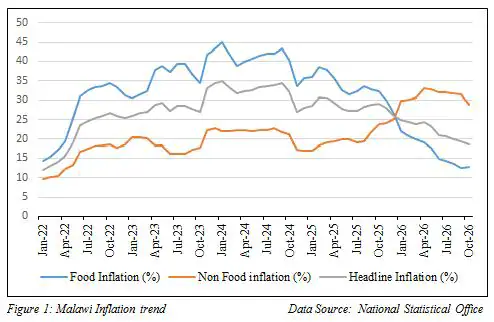
The Malawi Confederation of Chambers of Commerce and Industry (MCCCI) has expressed concerns that recent gains in containing inflation may be reversed due to rising global energy prices, exchange rate pressures, and higher transportation costs. According to the MCCCI's October 2026 Inflation Bulletin, annual inflation eased to 18.6 percent in October from 19.4 percent in September. However, monthly inflation remained elevated at 1.6 percent, and food inflation increased to 12.8 percent from 12.5 percent.
The MCCCI identified rising international oil prices, kwacha depreciation, and geopolitical tensions in the Middle East as major risks to Malawi's economy. These factors could increase the cost of imported fuel, fertiliser, machinery, and other production inputs, ultimately affecting businesses and households. The chamber emphasized that sustained high inflation continues to undermine purchasing power, increase working capital requirements, and create uncertainty around production and investment decisions.
The MCCCI also noted that Malawi continues to experience significantly higher inflation than some of its regional trading partners. In October, inflation stood at 6.3 percent in Zambia, 5.2 percent in South Africa, 4.3 percent in Zimbabwe, and 4.2 percent in Tanzania. This disparity raises concerns about Malawi's competitiveness, as persistently high domestic prices increase production costs and erode household purchasing power.
The Reserve Bank of Malawi (RBM) reported that inflation declined to 20.1 percent in the third quarter from 22.9 percent in the preceding quarter, largely reflecting improved food availability. However, non-food inflation remained elevated at 31.9 percent, pointing to continued pressure from other components of the economy. The central bank maintained its 2026 annual inflation projection at 22 percent, compared with 28.4 percent in 2025.
The RBM revised its 2027 inflation forecast upwards to 20 percent from an earlier projection of 18.5 percent, citing geopolitical tensions and an increased likelihood of El Niño conditions. The Economics Association of Malawi (Ecama) observed that the economy faced a daunting task of reducing inflation to 15 percent by March 2027, as food prices, electricity tariffs, fuel costs, and exchange rate pressures continue to weigh on economic activity.
Ecama warned that the disinflation process remains fragile due to high fertiliser prices, transportation costs, imported production inputs, and persistent kwacha depreciation. Scotland-based Malawian economist Velli Nyirongo cautioned that uncertainty surrounding inflation, exchange rates, and borrowing costs could undermine business confidence and investment decisions.
Nyirongo recommended that monetary policy should remain cautious, with interest rate reductions guided by sustained improvements in underlying inflation rather than temporary declines in food prices. The MCCCI emphasized the importance of ensuring that monetary and fiscal policies remain sufficiently aligned to contain inflation without unnecessarily constraining private sector investment and economic activity.
Key points
- Malawi's annual inflation eased to 18.6 percent in October from 19.4 percent in September.
- The country's inflation remains higher than that of regional trading partners, raising concerns about competitiveness.
- The RBM revised its 2027 inflation forecast upwards to 20 percent due to geopolitical tensions and El Niño conditions.
Reporting sources
- Businesses fear inflation rebound · The Nation