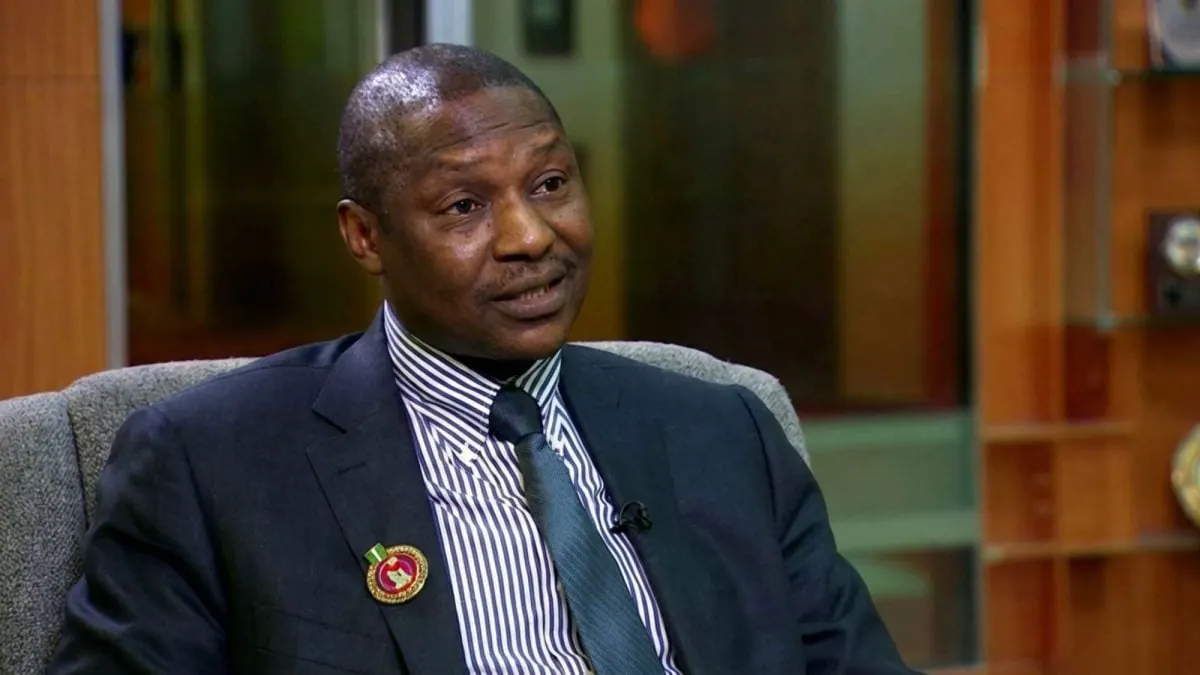
Former Attorney-General of the Federation and Minister of Justice, Abubakar Malami, has denied allegations of corruption linked to the Mambilla Hydroelectric Power Project settlement. Malami's response comes after reports on a 616-page arbitral award arising from a dispute between Nigeria and Sunrise Power over the Mambilla project. His office stated that Malami did not authorise or receive the $200 million settlement allegedly negotiated with Sunrise Power and Transmission Company Limited.
The Mambilla controversy dates back to 2003, years before Malami became Attorney-General. His predecessor, Michael Aondoakaa, had already reviewed the dispute and recommended an amicable resolution. A November 2012 General Project Execution Agreement involving Sunrise and Sinohydro showed efforts to resolve the dispute had commenced under previous administrations. Malami's involvement began after he assumed office and received a presidential directive in April 2016 concerning the outstanding disputes and competing interests surrounding the project.
Malami explained that the Federal Ministry of Justice's role was principally legal, advising the government on its potential exposure and options for resolving the dispute. The ministry's role did not involve executing the Mambilla project or awarding its underlying contracts. On the disputed $200 million settlement, Malami said Sunrise had initially demanded $500 million in November 2019 as full and final settlement, while Federal Government representatives countered with $100 million before $200 million emerged during negotiations.
The settlement discussions were driven by concerns over Sunrise's multibillion-dollar claims, prolonged litigation, and the effect of the unresolved dispute on efforts to finance the Mambilla project. Malami, however, emphasised that former President Muhammadu Buhari ultimately rejected the proposed $200 million payment. Buhari indicated on April 20, 2020, that the Federal Government did not have the money to pay Sunrise, a position he communicated to the company two days later.
A subsequent request for presidential approval in January 2021 was also rejected, with Buhari writing "Not approved." Malami further argued that his conduct after the rejection was significant, saying he instructed the Federal Government's lawyers to resist Sunrise's attempt to enforce the settlement terms against Nigeria after the company alleged that the government had defaulted. This move demonstrated Malami's efforts to protect Nigeria's interests in the dispute.
On allegations that he entered into a corrupt arrangement with Sunrise promoter, Leno Adesanya, Malami denied receiving or agreeing to receive any financial benefit in connection with the dispute. He said the allegation should be tested against the complete evidentiary record, noting that the settlement money was never paid to Sunrise. Malami maintained that any allegation of criminal wrongdoing should be addressed through the appropriate legal process.
Malami welcomed Nigeria's successful defence of the arbitration, saying the outcome protected the country from substantial financial exposure. The statement said the defence lawyers were engaged by Malami and that EFCC investigations undertaken to strengthen Nigeria's case were also conducted on his instructions. His office urged journalists and commentators to distinguish between established facts, allegations, and interpretations while examining the complete documentary record surrounding the Mambilla dispute.
Key points
- Malami denies corruption allegations related to the Mambilla Hydroelectric Power Project settlement.
- The Mambilla controversy dates back to 2003, before Malami's tenure as Attorney-General.
- Former President Muhammadu Buhari rejected the proposed $200 million payment to Sunrise Power.