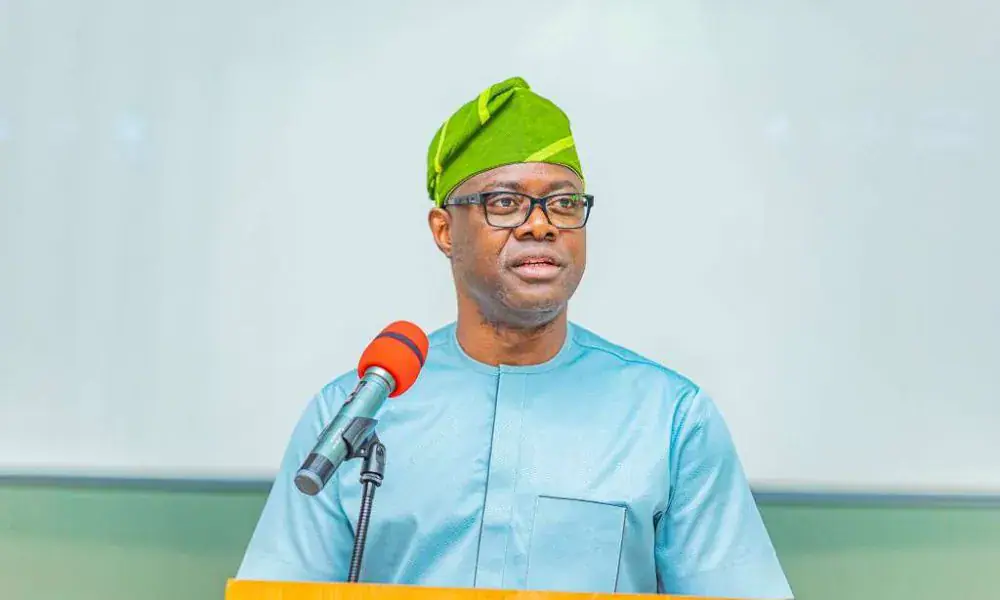
Oyo State Governor and Allied Peoples Movement (APM) presidential candidate Seyi Makinde has promised to deploy revenue generated from crude oil sales above the budget benchmark to improve the welfare and living conditions of Nigerians if elected president in 2027. He made this pledge during the unveiling of his presidential manifesto, tagged Reset Agenda, in Abuja on November 6, 2026. Makinde was accompanied by his running mate, Lawal Daura, and the APM National Chairman, Yusuf Dantalle.
Under Nigeria's budgetary framework, annual expenditure projections are based on a benchmark crude oil price, with earnings above the benchmark traditionally saved or distributed among the three tiers of government. However, Makinde argued that the benefits of increased oil earnings and broader economic reforms must be felt directly by ordinary Nigerians rather than reflected only in government revenue figures. He emphasized that the country's vast human and natural resources should translate into improved living standards.
Makinde questioned the rationale behind pursuing macroeconomic stability without corresponding improvements in the welfare of the population, describing the gap between economic reforms and the realities confronting Nigerians as a major national challenge. He called for a governance framework anchored on practical implementation strategies, measurable objectives, and institutional accountability, rather than political promises. Makinde said his administration would introduce clear performance benchmarks within its first 100 days in office.
The APM candidate also urged Nigerians to demand accountability from the Federal Government over its commitments to improving power supply, particularly in the persistent electricity crisis. He argued that the transfer of certain electricity regulatory and operational responsibilities to state governments under the new electricity law should not be used as an excuse by the Federal Government to abandon its responsibilities in the sector. Makinde emphasized that the challenges of electricity generation and distribution still require decisive intervention and coordination at the federal level.
Makinde explained his decision to contest the presidency, citing the need to confront Nigeria's development challenges and revive the aspirations of the country's founding fathers. He said his proposed administration would focus on improving the quality of life of millions of Nigerians, particularly rural dwellers, expanding access to opportunities without discrimination based on ethnicity or religion, and rebuilding public institutions. Makinde emphasized that his administration would develop people's abilities and expand their access to opportunities.
On electoral reforms and the country's political structure, Makinde advocated a system in which presidential candidates would be required to secure more than 50 per cent of votes cast to emerge victorious. He argued that such an arrangement would encourage political parties and candidates to build wider alliances and seek support beyond their traditional constituencies. Makinde also proposed the formation of a transitional government of national unity and the convocation of a national conference to deliberate on Nigeria's challenges.
Other speakers at the event, including Daura and Dantalle, expressed concern over attempts to weaken opposition parties and restrict the political space, emphasizing the need for a fair and transparent electoral environment. Dantalle called on the Independent National Electoral Commission to maintain neutrality and ensure that the forthcoming election was peaceful, transparent, and credible. The 2027 election is seen as an opportunity to determine the future of millions of Nigerians yearning for a fundamental change in the country's direction.
Key points
- Seyi Makinde pledges to deploy excess crude oil earnings to improve Nigerians' welfare if elected president in 2027.
- Makinde advocates for a governance framework with practical implementation strategies and institutional accountability.
- The APM presidential candidate proposes electoral reforms, including a system requiring candidates to secure over 50 per cent of votes cast to emerge victorious.