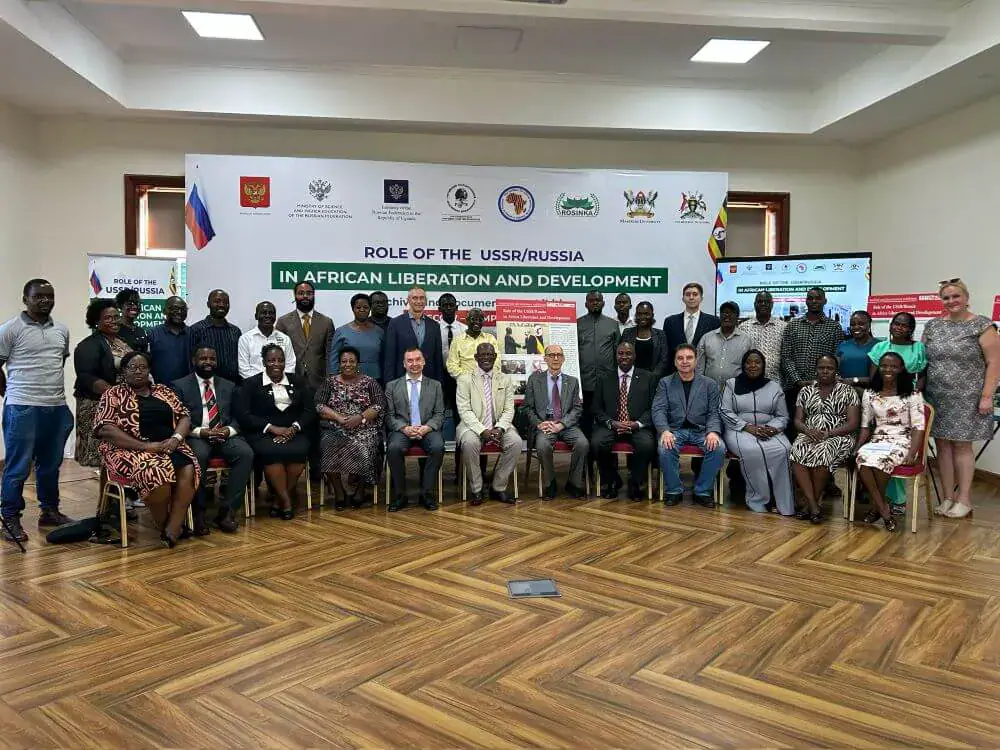
Makerere University recently opened an academic and documentary exhibition exploring the role of the former Soviet Union and Russia in Uganda's liberation and post-independence development. The exhibition, held at the university's College of Humanities and Social Sciences, features archival photographs and documents tracing Soviet engagement with African liberation movements and the contribution of Soviet-trained professionals to Uganda's development. This event was organised in collaboration with the Russian State University for the Humanities and the Coordinating Council of Russian Compatriots in Uganda.
The exhibition, themed "The Role of the USSR/Russia in the Liberation of Uganda," was opened by Makerere University Vice Chancellor Professor Barnabas Nawangwe. He emphasised the importance of preserving historical records and providing a fuller understanding of the forces that shaped Africa's struggle for independence. Nawangwe noted that universities have a responsibility to examine liberation history from multiple perspectives, highlighting the Soviet Union's assistance to Uganda after independence.
According to Nawangwe, Soviet medical personnel and other specialists contributed to the development of Uganda's health, science, and agricultural sectors. Educational exchanges helped Ugandans acquire professional skills needed to build the newly independent state. The exhibition documents Soviet engagement with liberation movements across Africa, including those in Angola, Mozambique, Namibia, Zimbabwe, and South Africa.
Uganda and Russia have a long-standing relationship, with diplomatic relations established on October 13, 1962. The Permanent Secretary in the Ministry of Foreign Affairs, Vincent Waiswa Bagiire, noted that the relationship has evolved towards economic cooperation, trade, science, and technology. An Intergovernmental Commission on Economic and Scientific-Technical Cooperation was established in 2015 to advance bilateral cooperation.
The Ministry of Foreign Affairs highlighted Uganda's participation as a partner country of BRICS since January 2025 and the planned participation of Uganda in the Third Russia-Africa Summit in Moscow on October 28-29, 2026. Uganda intends to pursue opportunities for Russian investment and cooperation in various sectors, including agro-industrialisation, tourism, and human capital development.
The Ministry of Education and Sports welcomed the Russian government scholarship programme, which provides a quota of 50 Ugandan students annually. The Ministry encouraged transparent access to scholarship opportunities and identified research, postgraduate training, and staff exchanges as priority areas for deeper collaboration between Ugandan and Russian universities.
The exhibition is expected to remain open for one month, giving students, researchers, and members of the public an opportunity to engage with the historical materials. The event provides a chance for scholars to investigate the relationship between international solidarity, political independence, and the development of African institutions.
Key points
- The exhibition examines the role of the USSR/Russia in Uganda's liberation and post-independence development.
- The event was organised in collaboration with the Russian State University for the Humanities and the Coordinating Council of Russian Compatriots in Uganda.
- Uganda and Russia have established an Intergovernmental Commission on Economic and Scientific-Technical Cooperation to advance bilateral cooperation.