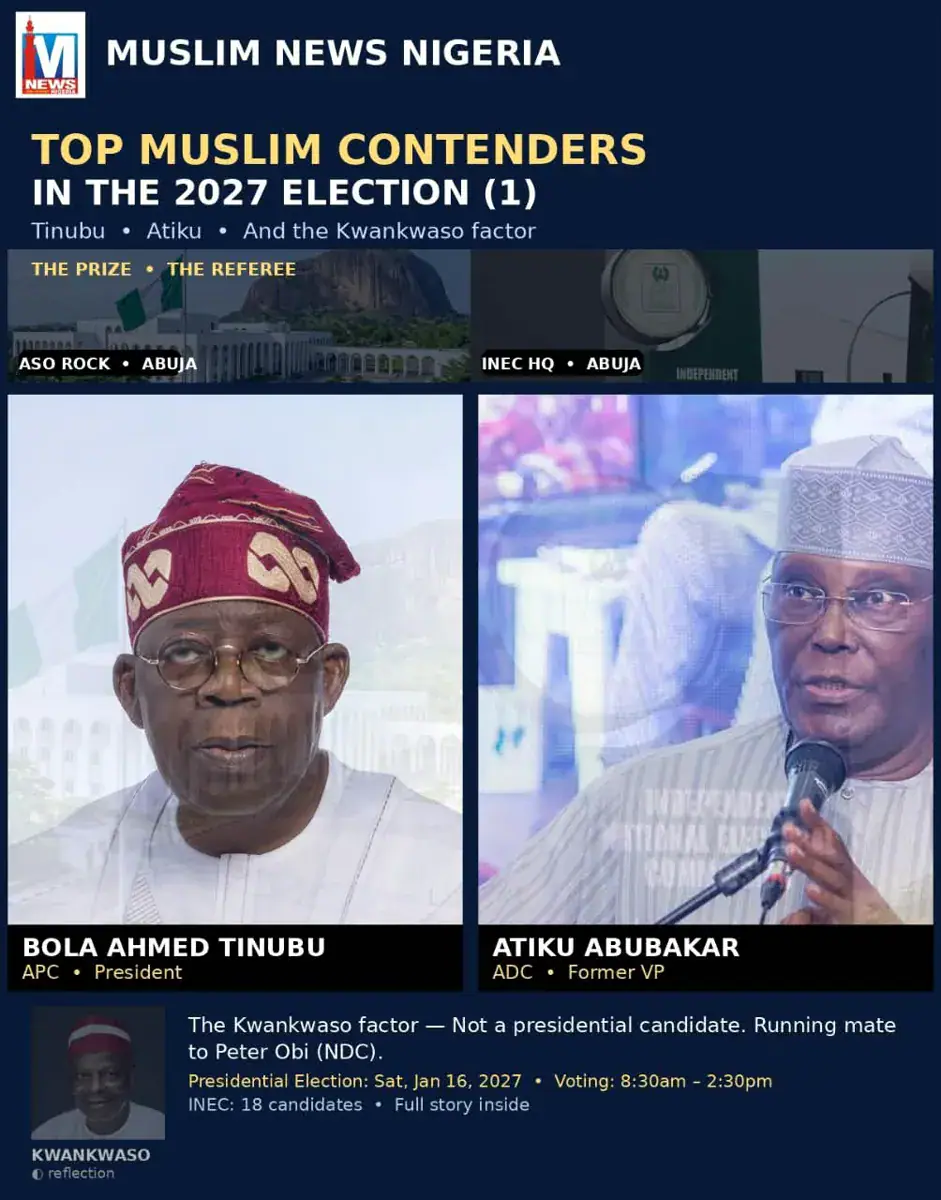
Nigeria's Independent National Electoral Commission (INEC) has published a final list of 18 presidential candidates from 18 political parties ahead of the 2027 general elections. Based on their names, several candidates appear to be of Muslim background, including President Bola Ahmed Tinubu of the All Progressives Congress (APC), former Vice President Atiku Abubakar of the African Democratic Congress (ADC), Abbas-Bin Aliyu of the Action Democratic Party (ADP), and Yusuf Kabiru of the Allied Peoples Party (APP).
The 2027 presidential and national assembly elections are scheduled for January 16, 2027, while the governorship and state houses of assembly elections will hold on February 6, 2027. The voting period will be from 8:30 a.m. to 2:30 p.m. Religion and regional interests significantly influence Nigerian politics, with political parties often balancing religious and regional considerations when selecting presidential candidates and running mates.
President Tinubu's administration has implemented significant economic reforms, including the removal of fuel subsidy and changes to the foreign exchange system. While the government defends these policies as necessary reforms, their impact on ordinary Nigerians remains a concern, with high food prices, transportation costs, and the rising cost of living affecting households and businesses.
Security is another major challenge facing the Tinubu administration, with insecurity persisting across different parts of the country, particularly in the Muslim-majority northwest and northeast. The government's response to these challenges, including efforts to protect vulnerable communities and secure the release of abducted persons, will be crucial for Muslim voters, particularly those in affected regions.
Tinubu's appointments have attracted criticism from sections of the Muslim community, particularly regarding representation in influential government positions. Some Islamic organisations and clerics have openly opposed Tinubu's re-election, while others have withheld their endorsement or expressed support for his administration. The Coalition of Over 1,000 Islamic Clerics and the Supreme Council for Shari'ah in Nigeria have criticised aspects of his administration.
Former Vice President Atiku Abubakar remains a major contender in the 2027 presidential race, despite his participation being surrounded by legal uncertainty. Atiku has significant political experience, having served as vice president and contested the presidency several times. His past criticisms of Tinubu's administration and policies may influence voters' decisions in the 2027 election.
The Muslim Ummah of South West Nigeria has indicated that it will not endorse any candidate for the 2027 election, urging Muslims to participate actively and vote for candidates who fear Allah and will govern with fairness, justice, and compassion. In contrast, some prominent Islamic organisations, such as Jama'atu Izalatil Bid'ah Wa Iqamatis Sunnah and the Qadiriyya Sufi order, have declared support for Tinubu's re-election.
Key points
- President Bola Ahmed Tinubu faces opposition from within the Muslim community regarding his appointments and policies.
- Former Vice President Atiku Abubakar's participation in the 2027 presidential race is surrounded by legal uncertainty.
- The Muslim Ummah of South West Nigeria will not endorse any candidate for the 2027 election.
Reporting sources
- TOP MUSLIM CONTENDERS IN THE 2027 ELECTION: Searchlight on the presidential race (1) · Muslim News Nigeria