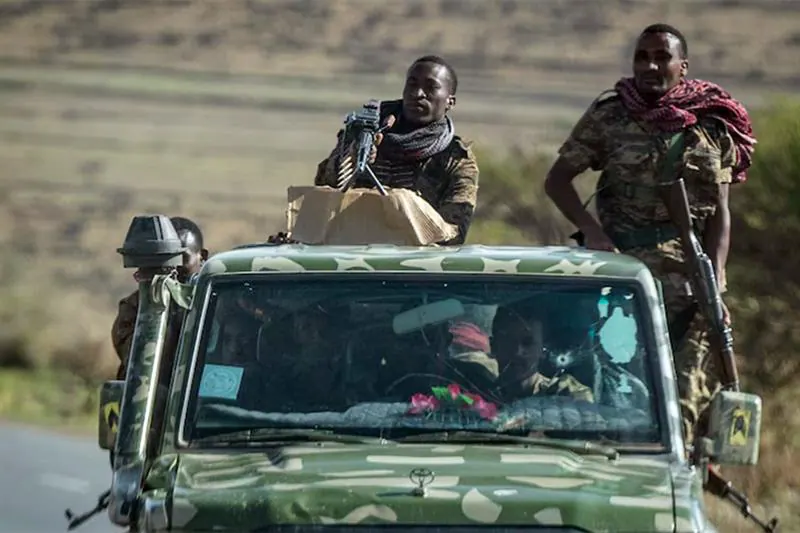
On Sunday, September 20, 2026, the main armed groups in Ethiopia, including those from the Tigray, Amhara, and Oromia regions, announced the formation of an alliance to overthrow the federal government and facilitate a transitional administration. Amanuel Assefa, vice-president of the Tigray People's Liberation Front (TPLF), stated that the alliance comprises seven armed groups, including the TPLF, Fano nationalist militia, and the Oromo Liberation Army (OLA). The groups aim to collaborate to achieve their objectives.
The formation of this alliance has raised concerns about the potential for increased instability in the Horn of Africa. Analysts believe that Ethiopia's regional ambitions could exacerbate the situation. The country has been plagued by armed conflicts in its two most populous regions, Oromia and Amhara, for several years. The federal forces have been fighting the OLA since 2018 and the Fano militia since 2023.
According to Kjetil Tronvoll, a specialist in the region at Oslo New University College in Norway, it is uncertain whether the armed groups can sustain a long-term conflict against the federal authorities, who possess significant military assets, including drones. However, Tronvoll noted that a coordinated military command could change the dynamics, potentially forcing the government to confront multiple fronts simultaneously.
Ethiopia, with a population of approximately 130 million people, has experienced a bloody conflict between 2020 and 2022 between federal forces and Tigrayan rebels, resulting in at least 600,000 deaths, according to the African Union (AU). The country has been led by Prime Minister Abiy Ahmed since 2018. The federal government has not yet commented on the newly formed alliance.
The alliance between the armed groups has significant implications for the region. The OLA, Fano, and TPLF have been fighting against the federal government for various reasons, including demands for autonomy and regional control. The TPLF, in particular, has a long history of conflict with the federal government, dating back to the 1990s.
The international community has expressed concerns about the escalating violence in Ethiopia. The conflict has already resulted in significant humanitarian crises, including displacement of people and loss of life. A peaceful resolution to the conflict remains elusive, and the formation of the alliance is likely to further complicate efforts to achieve stability.
The Ethiopian government faces significant challenges in addressing the root causes of the conflicts. The country needs to address issues of regional autonomy, economic inequality, and social injustice to prevent further instability. The international community, including regional and global powers, has a critical role to play in supporting efforts to achieve a peaceful resolution to the conflict.
Key points
- The main armed groups in Ethiopia have formed an alliance to overthrow the federal government and facilitate a transitional administration.
- The alliance comprises seven armed groups, including the TPLF, Fano, and OLA.
- The conflict has significant implications for regional stability, with concerns about the potential for increased instability in the Horn of Africa.