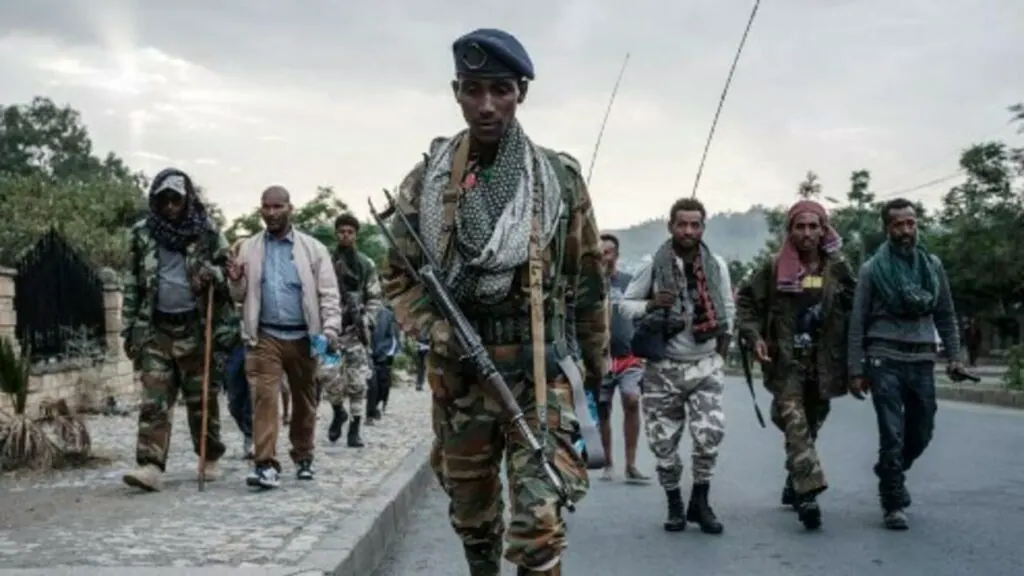
The main armed groups in Ethiopia, including those from the regional states of Tigray, Amhara, and Oromia, have formed an alliance to overthrow the federal government and facilitate a transitional government. Amanuel Assefa, vice-president of the Tigray People's Liberation Front (TPLF), announced the alliance, which comprises seven armed groups, including the TPLF, Fano nationalist militia, and the Oromo Liberation Army (OLA). The alliance aims to bring down the current regime and establish a transitional government.
The alliance was formed in response to the ongoing conflicts in Ethiopia, particularly in the Oromia and Amhara regions. The federal government has been fighting the OLA since 2018 and the Fano militia since 2023. The country has been plagued by armed conflicts for several years, resulting in significant human suffering and displacement. The Ethiopian government, led by Prime Minister Abiy Ahmed since 2018, has struggled to maintain stability and security in the country.
According to Kjetil Tronvoll, a specialist on the region at Oslo New University College, the armed groups may face challenges in sustaining a long-term conflict against the federal government, which has a significant advantage in terms of military resources, including drones. However, if the groups can coordinate their military efforts, they could potentially pose a significant challenge to the government, creating multiple fronts of conflict.
The Ethiopian government has not yet commented on the alliance, but it is likely to view it as a threat to its authority. The government has been working to assert its control over the country, particularly in the regions where armed groups are active. The formation of the alliance is likely to escalate tensions and potentially lead to further conflict.
Ethiopia has a population of approximately 130 million people and has experienced significant turmoil in recent years. The country has been working to recover from a devastating war between 2020 and 2022, which pitted the federal government against the TPLF and resulted in an estimated 600,000 deaths, according to the African Union. The war had a profound impact on the country, causing widespread destruction and displacement.
The international community is likely to be concerned about the development of the alliance and its potential implications for regional stability. Ethiopia is a key player in the Horn of Africa, and instability in the country can have ripple effects throughout the region. The African Union and other international organizations may seek to engage with the parties to the conflict to promote a peaceful resolution.
The situation in Ethiopia remains volatile, and it is unclear how the alliance will develop or how the government will respond. The coming weeks and months are likely to be critical in determining the course of the conflict and its potential impact on the country and the region. The humanitarian situation in Ethiopia is already dire, and further conflict could exacerbate the crisis.
Key points
- The main armed groups in Ethiopia have formed an alliance to overthrow the federal government and facilitate a transitional government.
- The alliance comprises seven armed groups, including the TPLF, Fano nationalist militia, and the OLA.
- The situation in Ethiopia remains volatile, and the international community is likely to be concerned about the development of the alliance and its potential implications for regional stability.