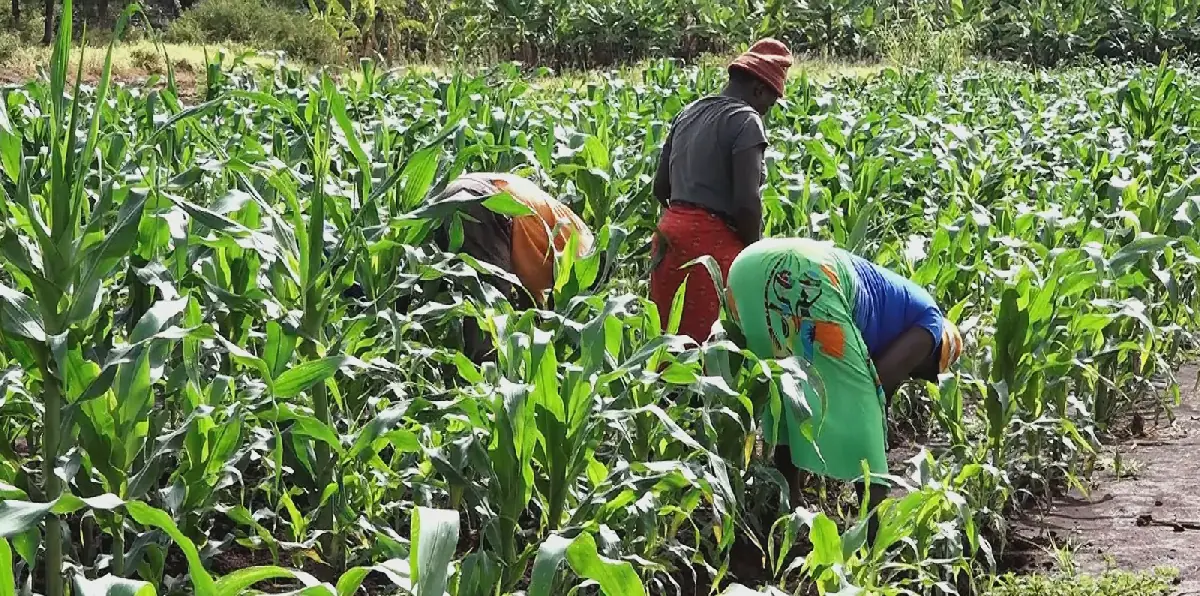
Kenya's land area under crop farming has increased by 126% over the past three decades, reaching 7.8 million hectares. This expansion has led to a significant increase in maize production, the country's main staple food. According to data from the Kenya National Bureau of Statistics (KNBS), the increase in agricultural land use was driven by conversions of grasslands mainly to support food and industrial crops.
The KNBS report, titled "Development of Land Accounts in Kenya," reveals that grasslands were largely converted into croplands, while forests were largely converted into grasslands and croplands. This conversion of land use has contributed to the growth in maize production, which recorded the highest increase from approximately 2.3 million tonnes to 3.3 million tonnes between 1990 and 2021.
Other crops, such as beans and Irish potatoes, also recorded significant increases in production over the same period. Bean production went up from 400,000 tonnes to 700,000 tonnes, while Irish potato production grew from 800,000 tonnes to 2.1 million tonnes. Rice production also increased from 40,000 metric tonnes to 200,000 tonnes over the three-decade period.
The KNBS attributes the impressive growth rates in crop production to the expansion of areas under cultivation and an increment in crop yields. However, the report also notes that industrial crops such as tea and sugarcane have been on the rise, while coffee and barley production has been on the decline due to sustained reductions in yields and acreage since 1990.
Despite the growth in agricultural production, the report highlights that only 20% of Kenya's land cover is suitable for medium to high-potential agriculture, with the majority being arid and semi-arid. Grasslands account for the largest share of Kenya's land area, covering 40,163,687 hectares, equivalent to 67.8% of the country's land area.
The Kenyan government has been promoting agricultural development through various initiatives, including the expansion of irrigation and the introduction of new technologies. The government aims to increase agricultural productivity and improve food security in the country. The KNBS report provides valuable insights into Kenya's land use and agricultural production trends.
The increase in maize production is a significant achievement for Kenya, as it reduces the country's reliance on imports and improves food security. With a total land area of 59,203,808 hectares, Kenya has a significant potential for agricultural growth, but it requires careful planning and management to ensure sustainable use of land and natural resources.
Key points
- Kenya's maize production has increased by 1 million tons due to a 126% expansion in croplands over three decades.
- The country's agricultural growth has been driven by conversions of grasslands into croplands and an increment in crop yields.
- Only 20% of Kenya's land cover is suitable for medium to high-potential agriculture, with the majority being arid and semi-arid.