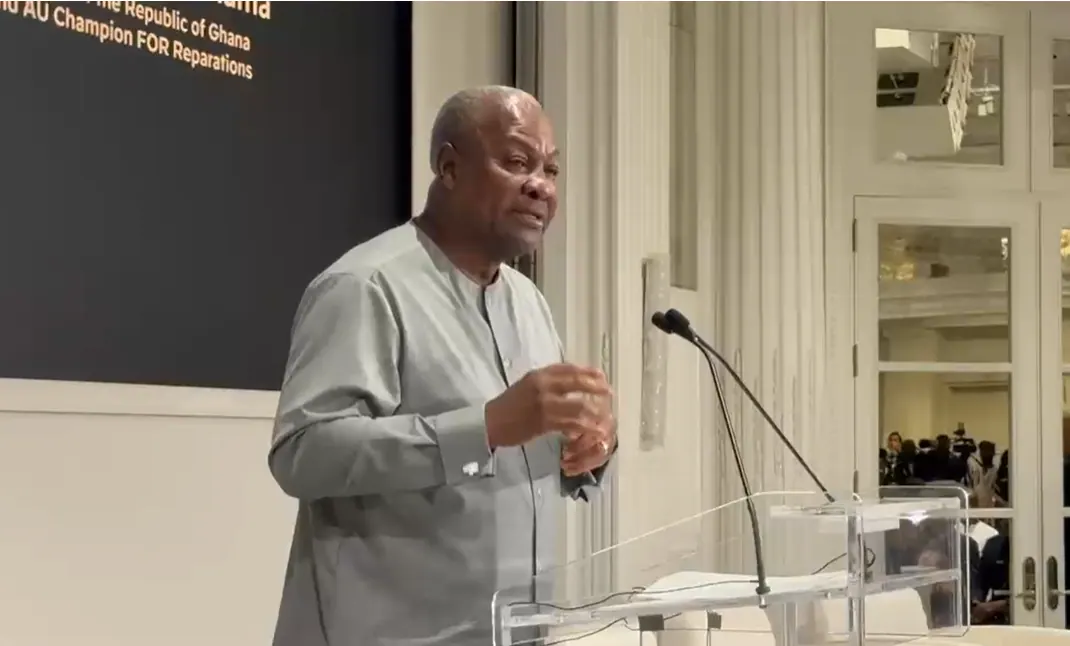
Former President of Ghana, John Dramani Mahama, has made a passionate appeal to the United Nations (UN) and UNESCO to take a leading role in creating stronger international frameworks. This framework aims to facilitate the return of African artefacts and ancestral human remains currently held in museums and private collections outside Africa. He made this call on Wednesday, September 23, 2026, during a high-level side event on reparatory justice in New York. This event was part of the activities marking the 81st United Nations General Assembly.
President Mahama emphasized that the continued possession of African artefacts and human remains is not merely a question of ownership but also one of dignity, identity, and justice. He stated that laws and procedures in countries holding African cultural properties should be reviewed. This review aims to reduce the legal and administrative barriers that make restitution difficult. Mahama argued that human remains are not collectibles or specimens but our ancestors, fathers, mothers, kings, and elders.
According to President Mahama, generations of Africans have been separated from important elements of their history and cultural identity. This separation occurred following the removal of artefacts and human remains during conquest, punitive expeditions, and colonial rule. He cited the 1874 British destruction and looting of the Asante Royal Palace in Kumasi as an example. Some of the heritage taken from Ghana has since been returned, including the Mpomponsuo sword in 2024.
President Mahama also referred to the case of King Badu Bonsu II of Ahanta, who was executed by Dutch authorities in 1838. His head was taken to the Netherlands for phrenological studies before his remains were returned to Ghana in 2009. He said such cases demonstrate the need for restitution efforts to cover not only cultural objects but also the human remains of Africans held abroad. Mahama stressed that restoring them is not a matter of legal ownership but a fundamental test of our shared human dignity.
President Mahama assured that Africa is prepared and has the capacity to receive and preserve returned cultural properties and human remains. He indicated that Ghana is prepared to commit to the development of appropriate museum facilities to preserve and safeguard such items. This commitment aims to ensure that returned artefacts and remains are properly conserved and made accessible for future generations.
The event where President Mahama made this call was a high-level side event on reparatory justice. It was held as part of the 81st United Nations General Assembly in New York. The focus of the event was on creating a framework for the return of African artefacts and ancestral remains. Mahama's speech highlighted the importance of international cooperation in addressing historical injustices.
President Mahama's call to the UN and UNESCO reflects a broader effort to address historical injustices. His initiative seeks to promote reparatory justice and the return of cultural properties and human remains to their rightful owners. The international community's response to this call will be crucial in determining the future of African artefacts and ancestral remains held abroad.
Key points
- Former President John Dramani Mahama calls on the UN and UNESCO to facilitate the return of African artefacts and ancestral remains.
- Mahama emphasizes the need for international frameworks to reduce legal and administrative barriers to restitution.
- Africa is prepared to receive and preserve returned cultural properties and human remains, according to President Mahama.