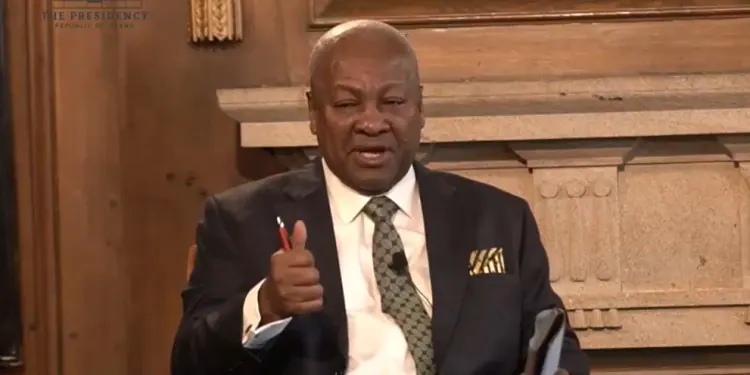
President John Dramani Mahama of Ghana has announced plans to list 10 state-owned enterprises on the Ghana Stock Exchange. This move aims to reduce political interference and increase accountability in these companies. Mahama made this statement at the Council on Foreign Relations in New York, on the sidelines of the United Nations General Assembly. He emphasized that listing these companies will make it harder for governments to arbitrarily sack boards.
The President's plan is part of a broader push to force state companies to operate with greater accountability and tie management decisions to actual financial performance. Mahama pointed out that some state enterprises have demanded higher salaries and bonuses for staff despite posting weak financial results. He argued that stronger governance structures, like those that come with a stock exchange listing, are needed to align pay and management decisions with company performance.
Mahama's remarks carry significant weight given his own record of dissolving boards of state institutions. In September 2026, he dissolved the boards of nine state institutions, including the Bulk Oil Storage and Transportation Company, the Volta Aluminium Company, Ghana Post, and the Ghana National Petroleum Corporation. Successive Ghanaian governments have routinely reshuffled or dissolved state-owned enterprise boards and management on taking office, undermining continuity and long-term planning.
The President's argument is that once private investors hold shares in these companies through a public listing, a future government would find it harder to sweep out a board or management team without regard to shareholder interests and stock market rules. This move would bring state-owned enterprises under the same rules as publicly traded companies. The State Interests and Governance Authority's 2025 State Ownership Report showed that the state-owned sector swung to a net profit of GH¢19.80 billion in 2025.
For ordinary Ghanaians and members of the diaspora, a listing on the Ghana Stock Exchange would open a route to buy shares in these companies, giving the public a direct financial stake in enterprises that have historically been run purely as government agencies. The government would proceed with the listings despite the improved performance of state-owned enterprises.
The State Interests and Governance Authority is expected to manage the listing process. However, Mahama's remarks did not name which of the state-owned enterprises are among the 10 earmarked for listing, nor did they set out a timeline for when the process might begin. No further details on the mechanics of the share sales, pricing, or which stakes the government would retain have been made public.
A state-owned enterprise is a company wholly or partly owned by government rather than private shareholders. The Ghana Stock Exchange is Ghana's official marketplace where shares of companies are bought and sold by the public. Listing a company there means offering some of its shares for public purchase, subject to disclosure and governance rules that apply to all listed firms.
Key points
- President Mahama aims to list 10 state-owned enterprises on the Ghana Stock Exchange to reduce political interference.
- The listings will make it harder for governments to arbitrarily remove management teams or dissolve boards.
- The move is part of a broader push to increase accountability and tie management decisions to actual financial performance.