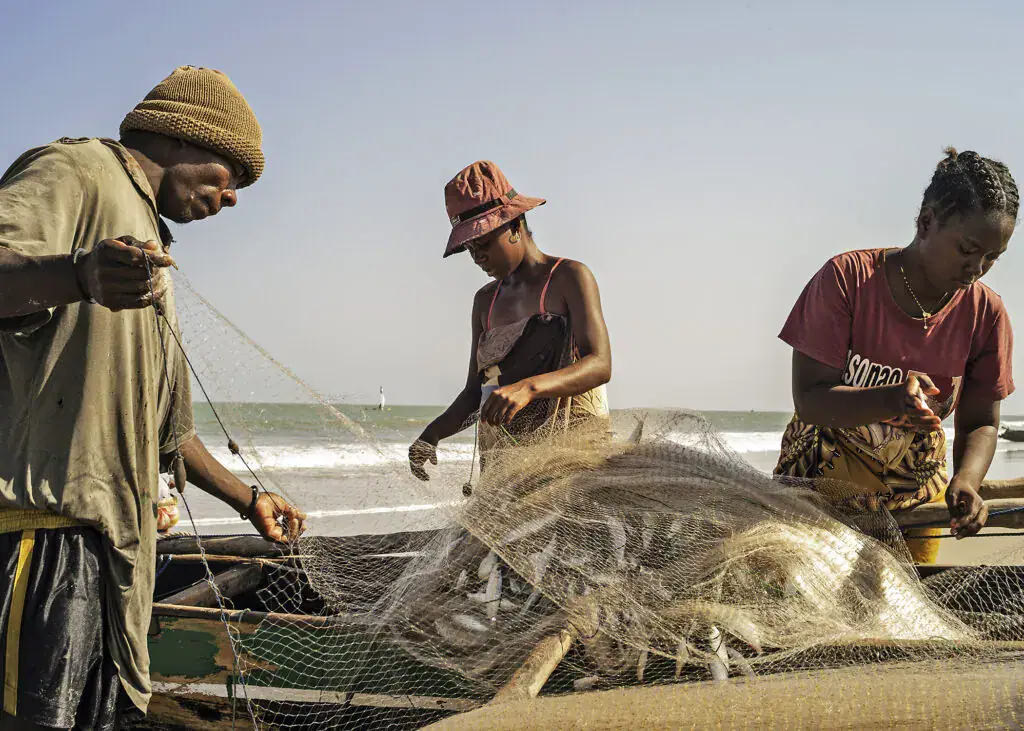
In the fishing village of Mantanito on Madagascar's Menabe coast, Vezo families build their own outrigger canoes and live off what they bring ashore. Fishers like Nariky, 46, say conditions at sea have grown more difficult, and they have to travel farther to find fish. Despite the challenges, Nariky was able to bring back around 20 kilos of fish, including sardines, crabs, and prawns, on a recent trip.
The Vezo communities have long made a living from the sea along Madagascar's western and southwestern shores. Their name is thought to come from the expression "mivehy izao," meaning "to handle an oar." Children often learn from an early age how to sail, fish, and read the sea. A traditional Vezo canoe is carved from a single log, often from the farafatse tree, whose wood is prized for its lightness.
To decide when and where to go out, Vezo fishers draw on knowledge passed down through generations. They watch the wind, tides, and currents, and know where to look for fish in different seasons. However, in recent years, Nariky says he has sometimes had to travel up to 50 kilometres to bring home enough fish. A 2022 study found that the number of hours when conditions allowed canoes to go out fell by about 22 hours per year between 1979 and 2020.
The study's lead author, Samantha Farquhar, says wind was the main factor determining when fishers could safely take their sailing canoes out. She notes that local observations and traditional knowledge are just as important as scientific data in understanding how the environment has changed over time. In Ampasimandroro, fishers interviewed said a southerly wind was the one that most often kept them ashore, and many said sailing or fishing became difficult or even dangerous when winds reached 25 to 30 km/h.
The Mantanito fishers' association, led by president Ramiandrisoa Sylvain, is working with nearly 800 fishers to adapt their fishing practices and give stocks time to recover. The association talks with fishers each week about changes they can make, such as respecting fishing seasons and adapting gear to reduce practices that harm fish populations. This effort aims to help Vezo fishers continue their trade in the face of growing challenges.
Climate change could also impact the amount of fish available to catch. Under pessimistic scenarios, Madagascar's maximum catch potential could be reduced by up to 6% by 2040 and by nearly 10% by 2050. Research also shows that fishing itself puts pressure on stocks, with many fish caught before they have a chance to reproduce. Nariky has already moved in search of a better living, coming to Mantanito from Andranopasy, a village south of Belo-sur-Mer.
Women like Mahereza, 20, play a crucial role in the fishing industry, selling fish at local markets and sometimes gathering shellfish or crustaceans. However, their sales often fall short of covering everyday expenses, and opportunities to earn money shrink further when bad weather keeps the canoes ashore. Despite these challenges, the Vezo fishers of Mantanito remain committed to their trade, with the local association working to support them in adapting to the changing environment.
Key points
- Vezo fishers in Madagascar face growing challenges at sea, including changing wind patterns and reduced fish populations.
- A local association is working with fishers to adapt their practices and protect resources.
- Climate change could reduce Madagascar's maximum catch potential by up to 10% by 2050.