The Luwero Triangle, a fertile agricultural region north of Kampala, was the epicenter of Uganda's Bush War, a brutal conflict that lasted from 1981 to 1986. The war was sparked by a disputed election that returned Milton Obote to power, prompting Yoweri Museveni and a small group of fighters to launch a guerrilla campaign. The National Resistance Army (NRA), led by Museveni, established itself in the Triangle, drawing support from local communities who opposed Obote's government.
The conflict escalated into a full-blown war, with government forces, known as the Uganda National Liberation Army (UNLA), responding with large-scale counter-insurgency operations. The UNLA, comprised mainly of soldiers from northern Acholi and Langi communities, was responsible for the majority of civilian deaths in the Triangle. Amnesty International and other human rights organizations documented widespread human rights abuses, including summary executions, looting, and destruction of farms and villages.
In 1983, the government launched Operation Bonanza, a major offensive that involved the forced removal of an estimated 750,000 people into military-controlled camps. Those who remained outside the camps were frequently treated as rebel supporters and subjected to brutal treatment. International observers estimated that at least 300,000 people died in the Luwero Triangle under Obote's regime, with some estimates suggesting that up to 500,000 people lost their lives across Uganda during the entire conflict.
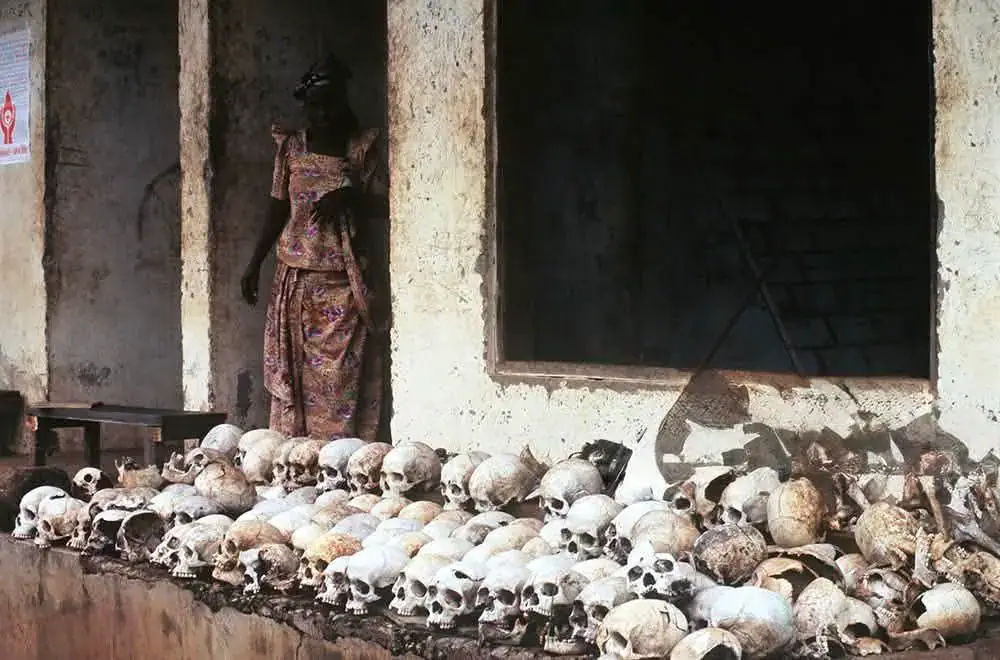
While the NRA was not entirely free of responsibility for civilian harm, its code of conduct emphasized restraint relative to government forces. However, the rebels did carry out targeted assassinations of suspected government collaborators and used child soldiers extensively. After the war, the NRA collected thousands of skulls and bones from mass graves and roadside sites across the Triangle, which were displayed publicly as evidence of the brutality of Obote's regime.
The display of human remains served a dual purpose: commemorating the dead and reinforcing the legitimacy of the post-1986 order. Estimates suggest that there were roughly 70,000 skulls across about 30 mass graves in the area. However, local residents and researchers have pointed out that not every set of remains can be attributed solely to one side, and identification of individual victims remains incomplete.
The Luwero Triangle conflict has left a lasting impact on the region, with many communities still seeking fuller accounting and recognition. Memorial sites continue to exist, although some have fallen into disrepair, and debates over their management and the historical narrative they support persist in Ugandan politics. The legacy of the conflict serves as a stark reminder of the devastating consequences of war and the importance of accountability.
Today, the image of rows of human skulls arranged outside a weathered building stands as a powerful symbol of the conflict's human cost, which remains only partially quantified. The story of the Luwero Triangle serves as a testament to the enduring impact of Uganda's Bush War and the need for continued efforts towards healing and reconciliation.
Key points
- The Luwero Triangle conflict resulted in an estimated 300,000 deaths under Obote's regime.
- The National Resistance Army (NRA) and government forces were both responsible for civilian harm during the conflict.
- The display of human remains in the Luwero Triangle served as a tool for commemoration and legitimation of the post-1986 order.