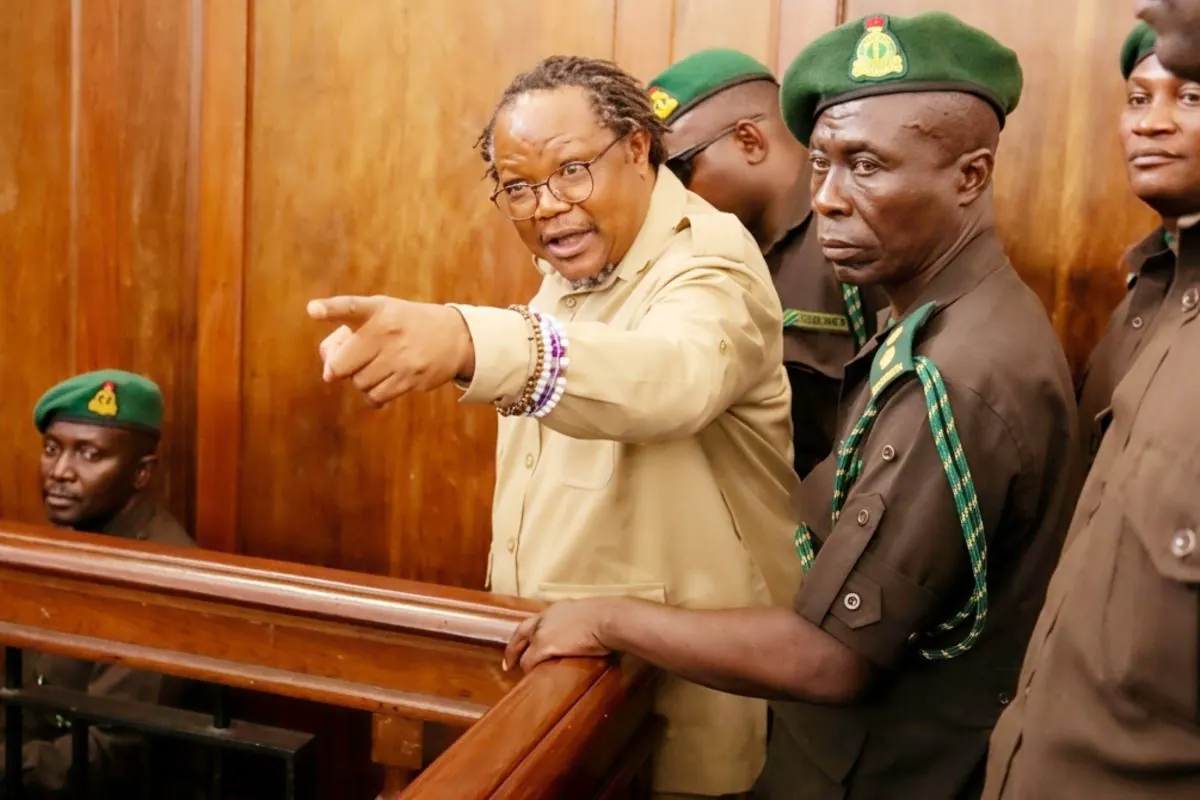
Chadema chairman Tundu Lissu has accused prosecution witnesses from the Police Force of giving contradictory evidence and misleading the High Court in his treason case. Lissu made the allegations as he presented his final submissions before a three-judge panel of the High Court's Dar es Salaam Sub-Registry. He singled out the evidence of Assistant Commissioner of Police George Bagyemu and ACP Amini Mahamba, the lead investigator in the case.
Lissu, who is also an advocate, said contradictions between the accounts of Bagyemu and Mahamba raised questions about the manner in which the investigation was conducted and whether the prosecution had proved its case to the required standard. He pointed to evidence concerning communication with the Director of Public Prosecutions' office and other security authorities, arguing that the accounts presented in court were inconsistent.
Lissu faces a treason charge under Section 39(2)(d) of the Penal Code, alleging that on April 3, 2025, he acted with seditious intent to incite the public to prevent the 2025 General Election through statements he made and published online. In his final submissions, Lissu asked the court to consider nine questions in determining whether the prosecution has proved the charge. He argued that the prosecution had failed to prove its case beyond reasonable doubt.
Lissu challenged Bagyemu's evidence, saying the officer played a central role in initiating the treason investigation. According to Lissu, Bagyemu testified that he instructed an officer to open a treason case file after reviewing a video containing the statements at the centre of the charge. Lissu argued that Bagyemu had not sought guidance from senior police officers before opening the file and had not obtained legal advice from the Office of the Director of Public Prosecutions.
Lissu compared Bagyemu's evidence with that of ACP Mahamba, saying their accounts differed on the composition of the investigation and legal advisory team. According to Lissu, Mahamba testified that the team included an officer from the National Prosecutions Service, while Bagyemu's evidence suggested that no lawyer had been part of the investigation team. Lissu said the discrepancy was significant because the prosecution witnesses were presenting different accounts of how the investigation was conducted.
Lissu also challenged the evidence of prosecution witnesses who testified under protection, with their identities concealed from the public. He argued that, apart from a Jambo TV journalist who testified openly, the other protected witnesses had personal interests that affected the reliability of their evidence. Lissu alleged that some had previously been involved in criminal cases that were withdrawn by police in exchange for their testimony.
The prosecution has maintained its case against Lissu, while the court is yet to determine the weight to be attached to the evidence and the competing arguments. The final submissions are being heard after the defence closed its case earlier this month. The court is expected to consider the defence arguments alongside the prosecution evidence before determining whether the charge has been proved to the criminal standard in accordance with the law governing criminal proceedings applicable.
Key points
- Lissu accuses police witnesses of giving contradictory evidence in his treason case.
- Lissu challenges the composition of the investigation team and the reliability of protected witnesses.
- The court is yet to determine the weight to be attached to the evidence and the competing arguments.