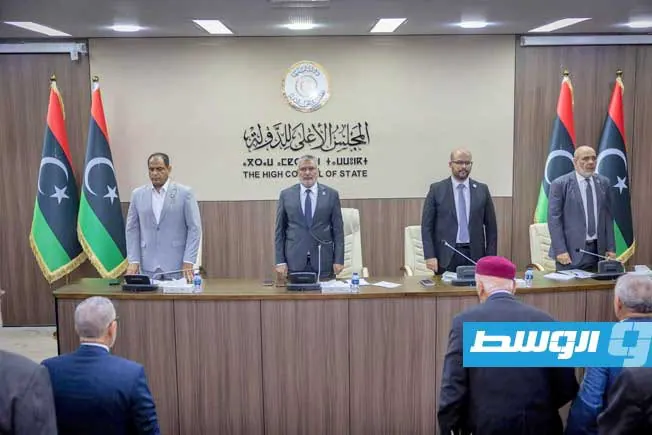
Libya's State Council voted on Monday, October 5, 2026, to reject the results of the "4+4" mini-committee, which aimed to find a solution to the country's ongoing political crisis. The council, in a session attended by 92 members, voted with a majority of 72 members to reject the committee's outcomes, citing a lack of national consensus and constitutional and legal references. The council also rejected, by consensus, what it described as "oversteps" by Parliament Speaker Aguila Saleh in issuing laws and decisions unilaterally.
The State Council's decision comes amid rising tensions between the council and the parliament over the country's electoral process. The council argued that the "4+4" agreement lacked a clear national consensus and constitutional and legal frameworks, and therefore could not be implemented. The council also emphasized its commitment to engaging with the United Nations' roadmap for Libya, which was launched in August 2025.
The State Council also discussed and rejected, by consensus, the decisions and laws issued by Parliament Speaker Aguila Saleh, which the council described as "unilateral" and contrary to the country's constitutional and legal frameworks. The council argued that these decisions, including the amendment of electoral laws, were not in line with the country's democratic transition process.
One of the key decisions rejected by the State Council was the amendment of the law governing the National High Commission for Elections. The parliament had issued a law amending the commission's structure, which the council saw as an attempt to undermine the commission's independence. The council also rejected the parliament's decision to freeze the law on the election of the House of Representatives.
The State Council also emphasized the need for a unified salary scale for all state institutions, as well as comprehensive economic and administrative reforms to promote functional justice and ensure the state's ability to meet its obligations. The council also called for any increase in salaries to be applied to retirees, in accordance with the law passed by the General National Congress in 2013.
The rejection of the "4+4" agreement and the decisions by Parliament Speaker Aguila Saleh reflects the ongoing divisions between the State Council and the parliament over the country's electoral process. The two institutions have been at odds over the best way to move forward with the country's democratic transition, with the State Council pushing for a more inclusive and consensus-based approach.
The State Council's decisions are seen as a significant development in Libya's ongoing political crisis, which has hindered the country's progress towards democratic elections. The council's rejection of the "4+4" agreement and the decisions by Parliament Speaker Aguila Saleh is likely to further complicate the country's electoral process, which has already been delayed several times.
Key points
- The State Council's rejection of the "4+4" agreement and decisions by Parliament Speaker Aguila Saleh reflects the ongoing divisions between the council and the parliament over the country's electoral process.
- The council's decision emphasizes its commitment to engaging with the United Nations' roadmap for Libya, which was launched in August 2025.
- The State Council's decisions are seen as a significant development in Libya's ongoing political crisis, which has hindered the country's progress towards democratic elections.