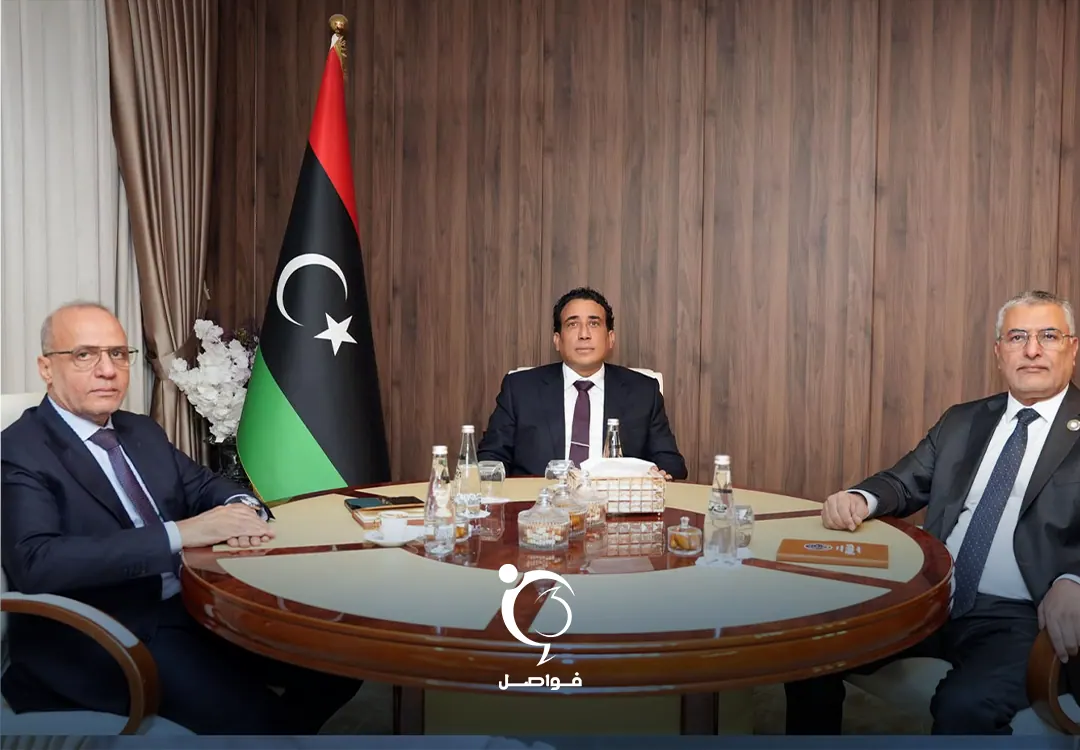
On September 29, 2026, Libyan Presidential Council head Mohamed al-Menfi and his deputy, Abdullah al-Lafi, met with High State Council head Mohamed Takkala to discuss implementing constitutional requirements and addressing the current political impasse. The meeting emphasized the need for any political agreements to adhere to constitutional and legal frameworks. The parties also stressed the importance of a comprehensive political process led by Libyans, with continued international support.
The meeting comes after the House of Representatives issued a package of laws and decisions on Monday, including amendments to the election of the head of state and the adoption of the 2014 law on the election of the House of Representatives. Other decisions included freezing the 2023 law on the election of the Council of the State and reconstituting the National High Commission for Elections.
Last September, House of Representatives head Aguila Saleh and High State Council head Mohamed Takkala agreed to resume meetings of the 6+6 committee in the coming days to complete tasks related to electoral laws. This aims to pave the way for proceeding with elections. The committee's work is seen as a crucial step towards achieving a peaceful and democratic transition in Libya.
The 6+6 committee was established to find a mutually acceptable solution for the electoral process. Its work involves representatives from both the House of Representatives and the High State Council. The committee's tasks include agreeing on laws for the election of the House of Representatives and the presidency.
Libya has faced significant challenges in recent years, including ongoing conflict and political divisions. The international community has repeatedly called for a peaceful resolution and the holding of elections to establish a legitimate government. The United Nations has been actively involved in supporting Libyan efforts to achieve stability and democracy.
The latest developments in Libya's political process have been closely watched by regional and international actors. The country's neighbors and international organizations have emphasized the importance of Libyan-led solutions to the crisis.
Key stakeholders, including the Presidential Council, the High State Council, and the House of Representatives, continue to engage in dialogue to overcome obstacles and move forward with the electoral process. Libya's progress towards stability and democracy remains a priority for the international community.
Key points
- The meeting between the Presidential Council and High State Council aimed to address the political deadlock and push for elections in Libya.
- The parties emphasized the need for any political agreements to adhere to constitutional and legal frameworks.
- The international community continues to support Libyan efforts to achieve stability and democracy through a peaceful and democratic transition.