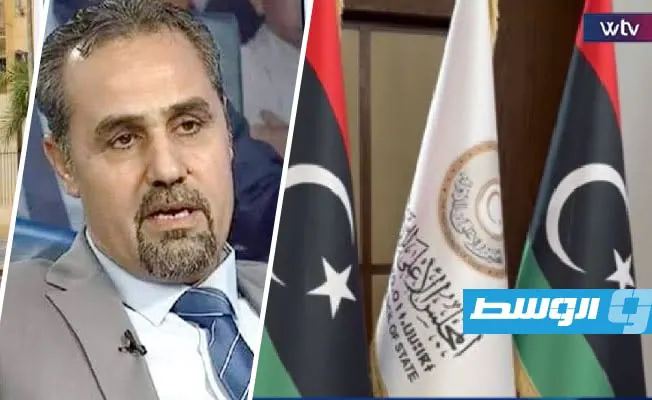
Member of the Libyan State Council, Sadeq bin Sharada, stated that Libya's political process cannot remain stalled due to disagreements between the House of Representatives and the State Council. He emphasized the need for a unified executive power to oversee the electoral process. Bin Sharada made these remarks during an interview with a local TV program on Monday. The current political stalemate has hindered progress in the country.
Bin Sharada expressed concerns that continued delays would only exacerbate the situation. He noted that the outputs of the 4+4 committee did not bring anything new regarding electoral laws and the High National Election Commission. However, he acknowledged that 119 lawmakers had previously accepted the committee's outputs. The committee's results are seen as an implementation of the previously agreed-upon road map.
The State Council and the House of Representatives have shown divergent views on the 4+4 committee's outputs. Bin Sharada stated that the State Council also has differing opinions on the matter. He warned that continued stalemate could lead to the bypassing of existing political bodies and a shift to another path to complete the road map. The current situation is described as "political, not legal."
Bin Sharada stressed that Libya needs a unified executive power to oversee the elections and enable Libyans to vote. He noted that the road map has been on the table for both councils since 2025 without implementation. The continued wait for consensus between the House of Representatives and the State Council will not serve the political process.
The role of the UN Support Mission in Libya was also discussed. Bin Sharada stated that the mission has supervised several committees and political dialogues since 2015. He noted that the formation of the 4+4 committee falls within this role and that its members represent Libyan parties and active forces on the ground.
Bin Sharada emphasized that any political initiative will face difficulties in implementation without the approval of existing powers on the ground. He stressed the need to reach a step that can lead Libya to conduct elections and end the political stalemate. The situation requires a unified approach to move forward.
In August, the State Council announced it was not part of the 4+4 committee. The council later voted to drop the membership of two members who participated in the committee's work. The developments reflect the ongoing challenges in Libya's political process.
Key points
- The need for a unified executive power to oversee Libya's electoral process.
- The current stalemate could lead to bypassing existing political bodies.
- The UN Support Mission plays a role in supervising Libyan political dialogues.