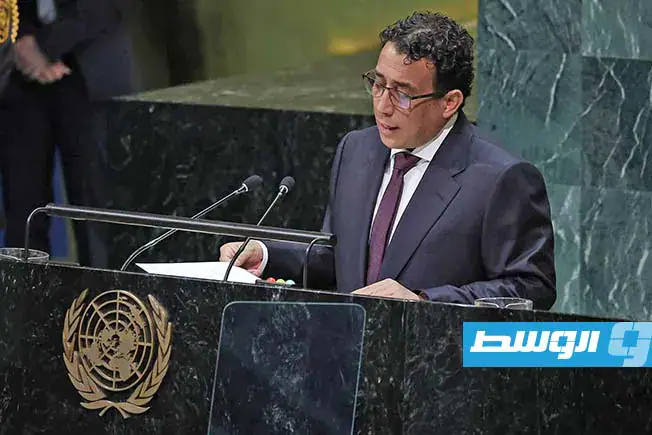
On September 23, 2026, Libyan Presidential Council head Mohamed al-Menfi addressed the 81st session of the United Nations General Assembly in New York. He emphasized Libya's desire for strong relationships with neighboring countries and the Arab world, based on mutual interests and respect for national sovereignty. Al-Menfi also stressed the importance of adhering to four key principles in any political process: respect for legitimacy and the constitution, national ownership, equal opportunities, and transparency.
Al-Menfi's statements align with those of Turkish President Recep Tayyip Erdogan, who also spoke at the UN General Assembly. Erdogan emphasized the need for a Libyan-led process to resolve the country's electoral impasse. This comes after a meeting in Turkey between the heads of the Libyan House of Representatives and the State Council, which agreed to revive the work of a joint committee to find a framework for elections.
The United States has also been involved in efforts to resolve Libya's crisis. US President's special advisor for the Middle East and Africa, Brett Puls, defended Washington's role in Libya, stating that US initiatives aim to achieve a comprehensive partnership rather than handing power to one side. Puls disputed reports suggesting that the US was promoting a deal that would see General Khalifa Haftar's deputy take over as head of state.
Meanwhile, tensions have escalated within the Libyan House of Representatives. A group of 86 lawmakers claimed they were prevented from holding a session to discuss reforms and the chamber's leadership. The lawmakers stated that they were blocked from entering the House of Representatives building in Benghazi, allegedly on the orders of the chamber's leadership.
The issue of a so-called "subversive cell" in Tripoli has also sparked controversy. The cell, allegedly comprising Libyan and foreign nationals, was accused of planning attacks on oil facilities and power plants. Presidential Council head al-Menfi subsequently announced that he had requested support from the International Criminal Court to investigate the matter. However, the government of Prime Minister Abdul Hamid al-Dbeiba emphasized that the case should be handled through local judicial channels.
Many Libyans and observers believe that the ongoing developments reflect a broader strategy to undermine the country's political process and maintain the status quo. The situation remains complex, with multiple stakeholders and external actors vying for influence. The international community continues to watch developments closely, as Libya's stability has significant implications for regional security.
The situation in Libya remains fluid, with various factions and external actors jockeying for position. As the international community continues to engage with the parties involved, it remains to be seen how the country's complex web of alliances and rivalries will evolve. One thing is certain: Libya's path forward will have far-reaching consequences for the country, the region, and the global community.
Key points
- The international community is closely watching developments in Libya.
- Libya's Presidential Council head Mohamed al-Menfi emphasized the country's desire for strong relationships with neighboring countries.
- The US has been involved in efforts to resolve Libya's crisis, with Brett Puls defending Washington's role in the country.
Reporting sources
- Wasat TV · Wasat TV