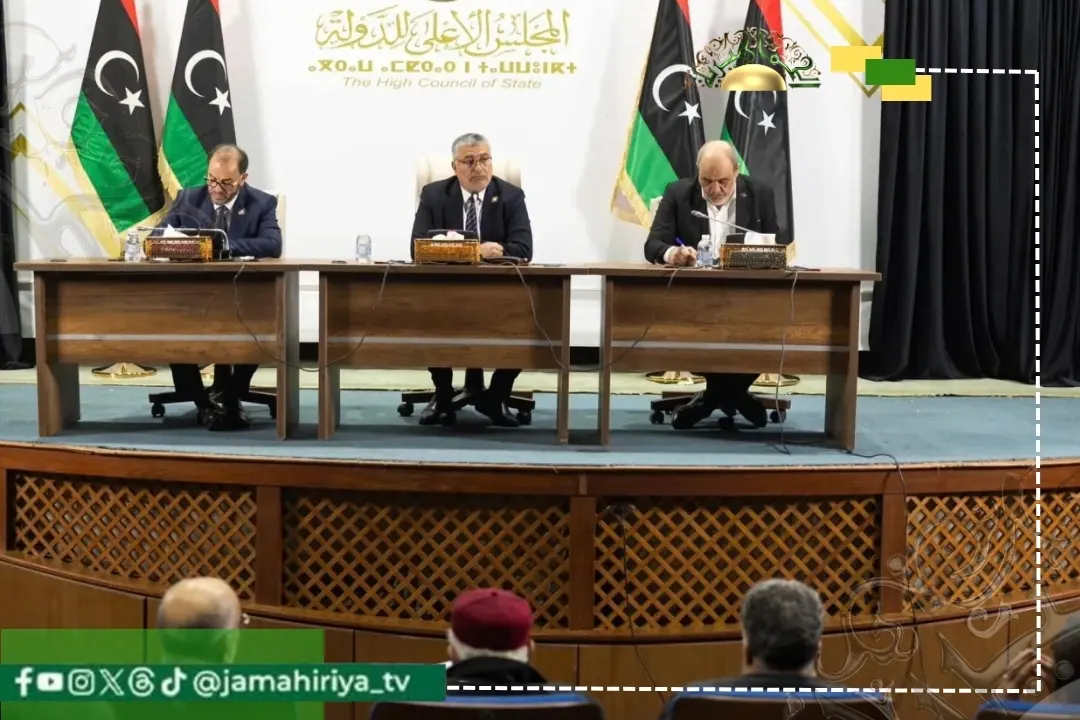
A rift has emerged between Libya's parliament and the state council over electoral laws, casting doubt on the country's political process. According to a report by "Erm News", the state council voted with a majority of 72 out of 92 members to reject the outcomes of the "4+4" committee. The committee was formed to find a solution to the electoral impasse. The state council also unanimously rejected what it termed as "oversteps" related to the issuance of laws and decisions unilaterally.
The disagreement centers on who has the authority to set and approve the rules governing the upcoming elections. The parliament has passed a package of laws and procedures related to the elections, including Law No. 3 of 2026 on the election of the parliament and Law No. 4, which amends the law on the election of the president. Law No. 4 stipulates that presidential and parliamentary elections should be held simultaneously within 24 months of the formation of a unified executive authority to oversee the elections.
However, the state council considers Law No. 4 to be unconstitutional and insists that any changes to the basic rules of the electoral process must be made through a participatory and institutional process, not unilaterally. The council bases its stance on the 13th constitutional amendment, which it believes established a participatory process between the parliament and the state council to prepare electoral laws.
The "4+4" committee meeting was seen as a breakthrough after months of stalemate, proposing the reformation of the election commission and addressing constitutional and legal issues, with a commitment to hold elections within two years. However, the current disagreement lies in the interpretation of the committee's outcomes. The state council views them as political understandings that require completion of institutional and legal procedures, while the parliament is moving forward with converting them into legislation and practical procedures.
The dispute has surpassed the content of the elections themselves, raising a broader question about who has the authority to approve the rules under which the elections will be held. The state council emphasizes that its objection concerns the method of managing the process, not a refusal to hold the elections. This development puts the agreement of August 30, which was supported by the parliament and the United Nations, to the test.
The Erm News report warns that continued disagreement could transform the legal conflict into a new political and institutional division. This could lead to one party considering the laws enforceable while the other challenges their legitimacy, coinciding with ongoing divisions in state institutions and calls for the formation of a unified government to oversee the elections.
The situation in Libya remains uncertain as the electoral process hangs in the balance. The international community is closely watching the developments, hoping for a resolution that would pave the way for a stable and democratic future in the country.
Key points
- The Libyan parliament and state council are at odds over electoral laws.
- The disagreement may hinder Libya's political process and electoral path forward.
- The situation's outcome could significantly impact Libya's future stability and democracy.