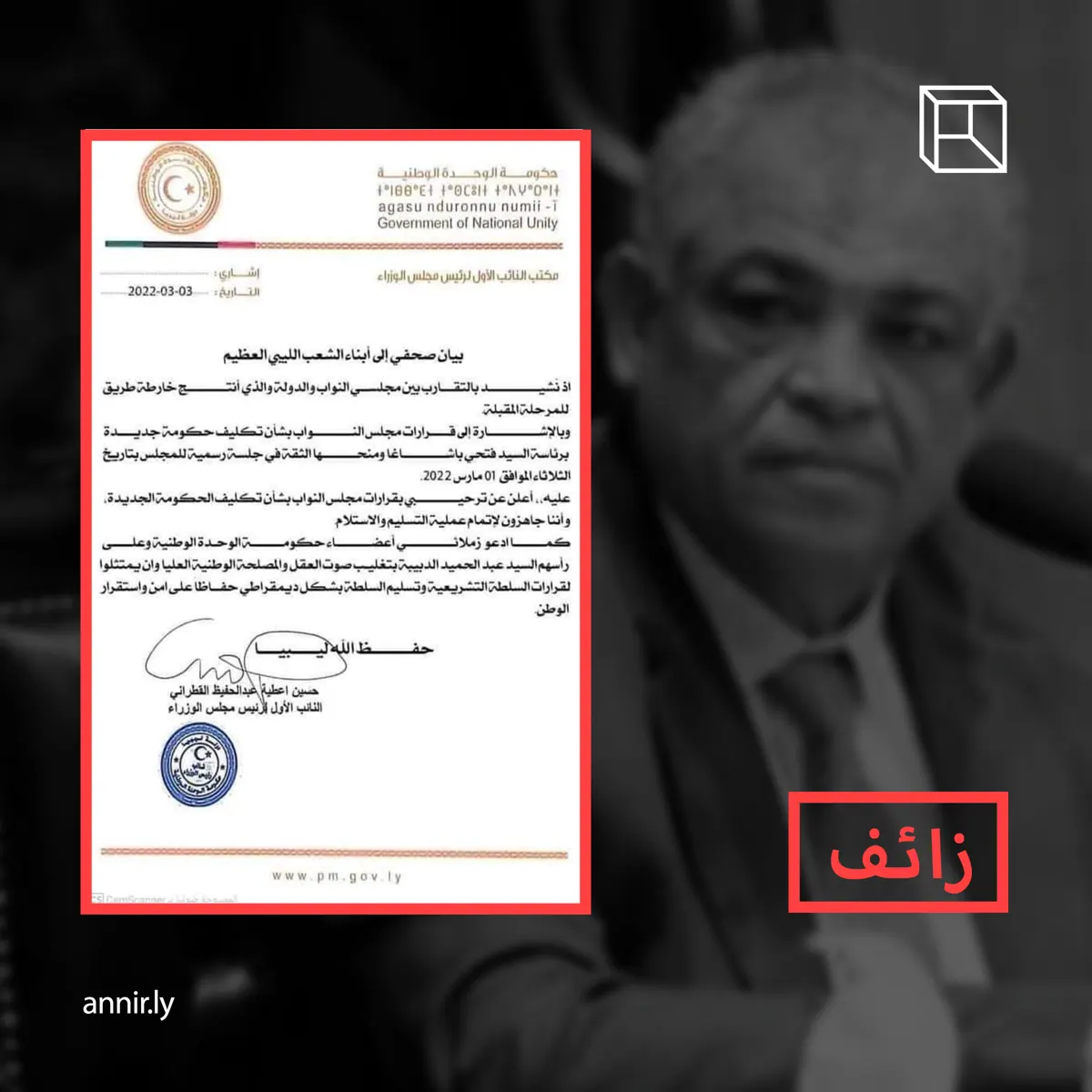
On March 3, 2022, a fake statement began circulating on social media in Libya, claiming that Deputy Prime Minister Hussein Al-Qatrani had announced the handover of power to a new government. The statement, which was shared on multiple Facebook pages, garnered significant attention, with nearly 1,000 interactions and 20 comments. However, an investigation by Annir, a fact-checking organization, revealed that the statement was entirely fabricated.
According to Annir's investigation, Al-Qatrani denied issuing the statement or making any comments about the current political situation. He emphasized that all official statements issued in his name follow a specific administrative procedure, including the assignment of reference numbers. The fake statement, which was widely shared, did not adhere to these procedures, confirming that it was indeed fabricated.
Al-Qatrani expressed his concerns about the intentions behind the fake statement, suggesting that its purpose was to create confusion and muddy the waters. He urged the public to verify information through official channels and to be cautious of misinformation spread through social media. The incident highlights the challenges of combating fake news in Libya, where social media plays a significant role in disseminating information.
The fake statement was shared on multiple Facebook pages, while other pages published the correct information, confirming that Al-Qatrani had not issued any statements about handing over power to a new government. Annir's investigation and Al-Qatrani's denial aimed to set the record straight and prevent further spread of misinformation.
This incident is not an isolated case of misinformation in Libya. Annir has previously debunked other fake news stories, including claims about the country's Islamic institutions and military operations. The spread of misinformation can have serious consequences, particularly in a country like Libya, which has faced significant turmoil and instability in recent years.
The incident underscores the importance of fact-checking and verifying information, especially in the context of Libya's complex and sensitive political landscape. By debunking fake news stories, organizations like Annir play a crucial role in promoting media literacy and helping the public make informed decisions.
In conclusion, the fake statement about Libya's government handover has been thoroughly debunked, and Deputy Prime Minister Al-Qatrani has confirmed that he did not issue the statement. The incident serves as a reminder of the need for vigilance and critical thinking in the face of misinformation.
Key points
- - Deputy Prime Minister Hussein Al-Qatrani denies issuing a fake statement about handing over power to a new government in Libya. - The fake statement was widely shared on social media, but an investigation by Annir revealed that it was fabricated and did not follow official procedures. - The incident highlights the challenges of combating fake news in Libya and the importance of fact-checking and verifying information.