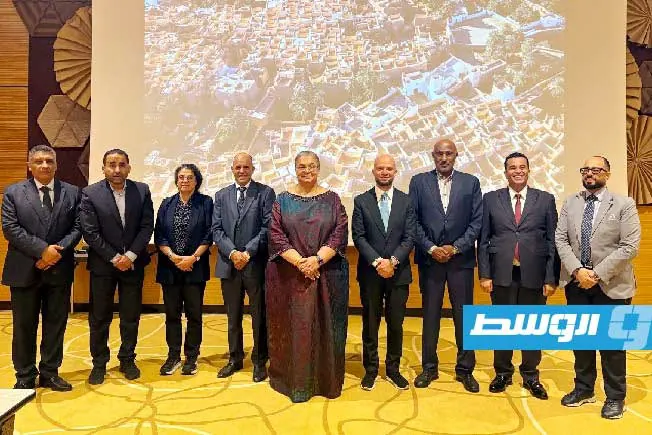
Members of Libya's 4+4 committee have reaffirmed their commitment to implementing the agreement signed on August 30, aimed at organizing national elections that meet the aspirations of Libyans for stability and prosperity. The committee, which consists of four representatives from the House of Representatives and four from the High Council of State, held a meeting in Tripoli on September 20 to review progress on the agreement. The meeting was attended by UN Special Representative for Libya, Hanna Titihe, and her deputy, Stephanie Khouri.
The 4+4 committee's agreement aims to address two key issues: the formation of a new board of directors for the High National Elections Commission and the amendment of electoral laws. The agreement allows military personnel to vote and run for president, and also permits dual nationals to run for office, provided they renounce any non-Libyan nationality before taking the oath of office. The agreement also separates the results of presidential and parliamentary elections and abolishes the requirement for a second round of voting if a presidential candidate receives more than 50% of the votes.
The 4+4 committee's agreement has been met with mixed reactions from various Libyan institutions. The House of Representatives has endorsed the agreement, but the High Council of State has expressed reservations. The committee's meeting on September 20 was the ninth in a series of small dialogue sessions, and the first since the signing of the agreement on August 30. The committee agreed to continue communicating with local parties to garner maximum support for the agreement.
The UN Support Mission in Libya (UNSMIL) reported that the meeting reviewed various positions on the agreement, particularly the supportive stance of the international community, including the UN Security Council and the House of Representatives. The committee also agreed to hold another meeting in the first week of October to continue monitoring progress on the agreement. UNSMIL described the meeting as a follow-up to the agreement signed in Tripoli on August 30.
The 4+4 committee's agreement is seen as a crucial step towards resolving Libya's protracted political crisis. The country has been plagued by instability and division since the 2011 uprising that toppled Muammar Gaddafi. The agreement aims to pave the way for national elections, which are seen as essential for achieving stability and prosperity in Libya. However, the agreement's implementation remains uncertain, given the reservations expressed by some Libyan institutions.
The Libyan parliament's endorsement of the 4+4 committee's agreement was announced on September 15, when the House of Representatives voted to approve the final agreement. The endorsement was welcomed by the UN Secretary-General, who described it as a positive step towards achieving stability in Libya. However, the agreement's implementation will require continued support from all parties involved.
The 4+4 committee's agreement has been hailed as a significant achievement, given the complex and often contentious nature of Libyan politics. The agreement's success will depend on the continued commitment of all parties involved, as well as the support of the international community. Libya's stability and prosperity depend on the successful implementation of the agreement and the holding of national elections that are free, fair, and transparent.
Key points
- The 4+4 committee's agreement aims to address key issues, including the formation of a new board of directors for the High National Elections Commission and the amendment of electoral laws.