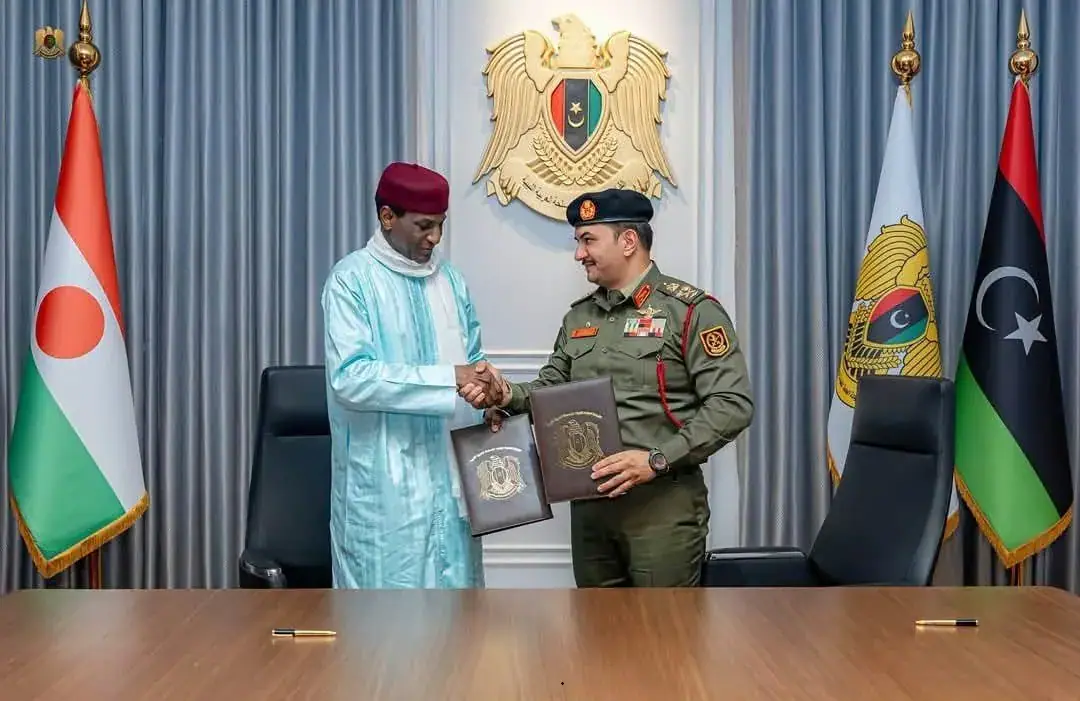
Libyan General Khalifa Haftar has hosted Nigerien Prime Minister Ali Amin Zein in the city of Benghazi, accompanied by a high-level delegation including senior military and political leaders. This meeting comes days after Algeria announced the deployment of military units to Niger, a move seen as an expansion of its military presence beyond its borders. The Algerian parliament had approved the deployment on October 25, 2026.
The rapprochement between Libya and Niger is seen as a significant development in the region, aimed at countering Algerian influence in the Sahel. The agreement signed between the two countries is expected to strengthen ties between them and undermine Algerian efforts to expand its presence in the region. This move is also seen as a boost to the relations between Niger and the Haftar family.
Algeria's decision to deploy troops to Niger has been seen as a bid to assert its influence in the Sahel region. However, the move has been met with skepticism by some, who argue that it may not be effective in addressing the security challenges in the region. The deployment has also raised concerns about the potential for increased militarization in the region.
The agreement between Libya and Niger is seen as a strategic move to counter Algerian influence in the Sahel. The two countries have a shared interest in promoting stability and security in the region, and the agreement is expected to facilitate cooperation on issues such as border security and counter-terrorism.
The Haftar family has played a significant role in Libyan politics, with Khalifa Haftar serving as the commander-in-chief of the Libyan National Army. His son, Saddam Haftar, has also been involved in the country's politics and has been a key figure in the country's military. The family's influence extends beyond Libya, with Khalifa Haftar having played a role in regional security issues.
The Sahel region has been plagued by security challenges, including terrorism and banditry. The region's instability has had significant humanitarian and economic impacts, with many countries in the region struggling to address these challenges. The agreement between Libya and Niger is seen as a step towards promoting stability and security in the region.
The implications of the agreement between Libya and Niger are significant, with the potential to reshape the security landscape in the Sahel region. The move is seen as a challenge to Algerian influence in the region and may have significant consequences for regional politics. The agreement is also expected to have an impact on the relations between Libya, Niger, and other countries in the region.
Key points
- The agreement between Libya and Niger aims to counter Algerian influence in the Sahel region.
- The agreement is expected to strengthen ties between Libya and Niger and promote stability and security in the region.
- The move has significant implications for regional politics and may reshape the security landscape in the Sahel.