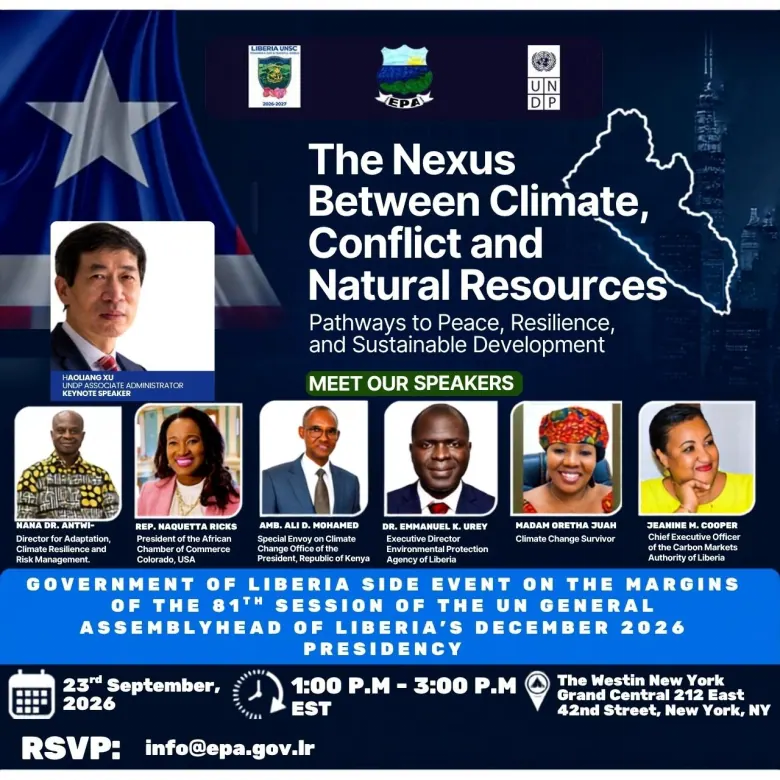
Liberia will use the global spotlight of the United Nations General Assembly to make the case that a changing climate and a fragile peace cannot be treated as separate problems. The government, through its Environmental Protection Agency (EPA) and with support from the United Nations Development Programme (UNDP), will convene a high-level side event on the margins of the Assembly. The event, titled “The Nexus between Climate, Conflict, and Natural Resources: Pathways to Peace, Resilience, and Sustainable Development,” is expected to bring together government leaders, UN officials, climate experts, development partners, civil society groups, academics, and private sector representatives.
Participants will explore how climate change, natural resource management, and peacebuilding are increasingly intertwined, and why progress on one often depends on progress on the others. The gathering comes as Liberia prepares to assume the Presidency of the UN Security Council in December 2026. The timing reflects the country’s growing voice on climate security, environmental governance, conflict prevention, and sustainable development. Liberia’s own experience illustrates both the promise and the peril of managing natural resources and addressing climate change.
At the heart of the discussion is the view that climate change acts as a “threat multiplier,” deepening existing problems such as poverty, inequality, resource scarcity, and weak governance. In Africa and other climate-vulnerable regions, environmental pressures are intensifying competition over land, water, forests, fisheries, and other natural assets. That competition, in turn, raises the risk of tension within communities and threatens wider stability. Liberia has made significant progress in consolidating peace and strengthening environmental governance.
However, the country continues to confront serious threats, including coastal erosion, illegal mining, deforestation, and the encroachment of wetlands. Organizers say these pressures show why development in Liberia and elsewhere must be both climate-resilient and sensitive to conflict. Haoliang Xu, UNDP Associate Administrator, will deliver the keynote remarks. He will be joined by a panel of international and African leaders, policymakers, and climate experts.
Discussions will center on five themes: climate change as a threat multiplier; the relationship between natural resources and conflict; climate-related displacement and mobility; governance, institutions, and peacebuilding; and pathways to resilience and lasting peace. Organizers say the event is designed to produce practical policy recommendations and to strengthen international partnerships. It also aims to attract investment and climate finance and to give local and community voices a stronger role in shaping efforts to build peace and resilience.
The forum will also give Liberia a platform to showcase its work in forest conservation, wetland protection, sustainable natural resource management, and climate policy. At the same time, the country intends to press for increased adaptation financing and stronger support for nations on the frontlines of climate change. Liberia’s experience in managing its natural resources and addressing climate change will be an important part of the discussion.
The side event is an opportunity for Liberia to demonstrate its commitment to addressing the interconnected issues of climate change, conflict, and natural resources. The event will provide a platform for Liberia to share its experiences and best practices with the international community. Key points from the event will likely inform future discussions on climate security, environmental governance, and sustainable development.
Key points
- The event aims to produce practical policy recommendations and strengthen international partnerships.
- Liberia will use the event to showcase its work in forest conservation, wetland protection, and sustainable natural resource management.
- The discussion will center on the interconnected issues of climate change, conflict, and natural resources.