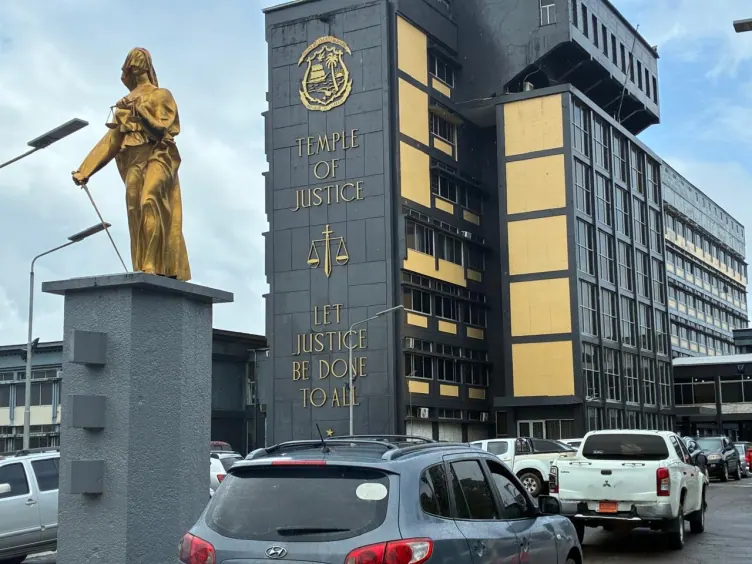
In a trial that has garnered significant attention in Liberia, three video recordings depicting the distribution of Saudi-donated rice were presented by the defense as its first witness continued testifying. Archievo Doe, a former National Disaster Management Agency (NDMA) communications official, presented the footage before Criminal Court “C” as part of the defense’s effort to challenge the prosecution’s account of how the rice was distributed. The videos were recorded in 2023 and 2024.
The defense is seeking to use the footage, alongside media reports, community witnesses, and distribution records, to challenge aspects of the Asset Recovery and Property Retrieval Taskforce’s investigation. However, the recordings’ dates, locations, and the identities of those involved remain important considerations in determining whether the distributions shown relate to the specific transactions at issue in the case. The footage alone does not establish who authorized each distribution or whether the transactions complied with established procedures.
The defendants, including former Foreign Affairs Minister Dee-Maxwell Saah Kemayah, have pleaded not guilty and remain presumed innocent unless proven guilty. Doe also referenced media coverage that he said documented the distribution of the Saudi-donated rice. He specifically mentioned Joseph Daniel, a former mainstream journalist now associated with the Asset Recovery and Property Retrieval Taskforce, who Doe said had previously reported on the distribution.
Testifying about the Caldwell distribution, Doe said the project’s concept note provided for two bags of rice per disaster-affected family. However, he told the court that the Togbah family received 150 bags. Doe testified that he signed the waybill associated with the movement of the consignment from the General Services Agency warehouse. According to him, the rice was loaded onto an NDMA truck operated under the supervision of the Armed Forces of Liberia.
Doe also testified that on October 2, 2023, Williams instructed him to deliver 50 bags of rice to Faith Caring Daycare and Elementary School in Chicken Soup Factory because the executive director was occupied with other responsibilities. He said the school had been affected by flooding that disrupted academic activities. Doe testified that information collected in the community identified 157 affected persons or infrastructure-related cases.
Doe challenged the manner in which investigators handled his case, testifying that the two waybills associated with the Caldwell and Chicken Soup Factory distributions were not presented to him during questioning. He said ARREPT sent him questions concerning his alleged involvement, but he considered some insufficiently specific. He testified that he requested clarification and eventually responded to approximately 18 questions.
The trial continues with the defense presenting its evidence, and the jury will have to consider the competing accounts presented by both sides. The indictment reportedly alleges that 25,054 of the 29,412 bags of donated rice were unlawfully handled, diverted, or misapplied. Key points include:
Key points
- The defense presented three video recordings of Saudi-donated rice distribution.
- The recordings were used to challenge the prosecution’s account of how the rice was distributed.
- The trial continues with the defense presenting its evidence.