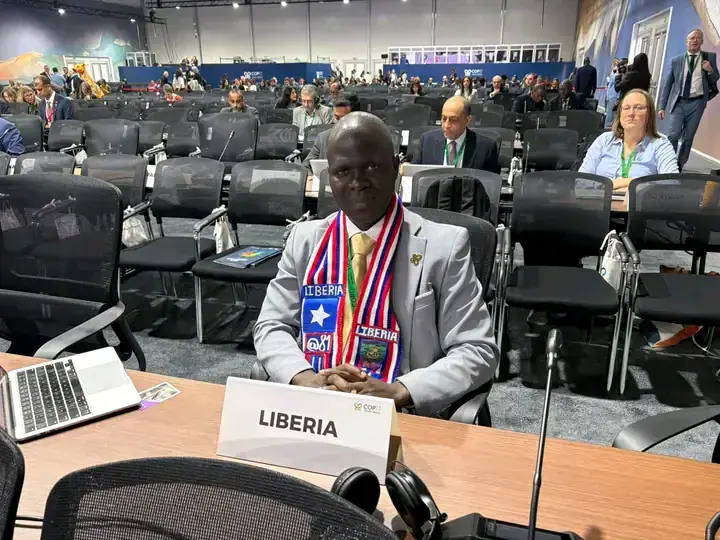
Liberia's head of Environmental Protection Agency, Dr. Emmanuel King Urey Yarkpawolo, addressed the high-level segment of the 17th Conference of the Parties to the Convention on Biological Diversity in Armenia. He spoke on behalf of President Joseph Nyuma Boakai, Sr., emphasizing that wealthy nations must support their conservation promises with funding, technology, and training. This appeal was made to ensure the effort to halt nature's decline succeeds in places that need help most.
Dr. Yarkpawolo cited two recent cases in Liberia to anchor his appeal. In Caldwell, residents killed a crocodile due to fear for their safety. In Monrovia, a stranded dolphin was reportedly killed before fisheries officials could reach it. These cases highlight a shared failure: ordinary people lack guidance on handling distressed animals, and the state lacks the means to respond quickly. The incidents demonstrate that protecting wildlife cannot come at the expense of families' security.
Dr. Yarkpawolo stated that Liberia stands with the African Group on four priorities. Firstly, he wants global targets paired with real implementation support. Reviews of progress should assess not only conservation results but also whether developing nations were given the means to deliver. This would ensure that countries are not solely judged on their conservation achievements but also on the support they receive.
The second priority involves biodiversity finance that is sufficient, predictable, timely, and easy to reach. Liberia backs Africa's push for a permanent financial mechanism answerable to the Conference of the Parties, with simpler application procedures and direct access for developing countries. Many African governments have complained that cumbersome funding rules slow projects and hamper responses to emerging threats.
Dr. Yarkpawolo also pressed for stronger capacity and technology transfer. In Liberia, this would involve training wildlife emergency teams, expanding research and monitoring, equipping laboratories, and running public education campaigns in languages people understand. Furthermore, he urged fair sharing of benefits drawn from biological resources, including digital sequence information.
Dr. Yarkpawolo informed delegates that Liberia has revised its national biodiversity targets and updated its National Biodiversity Strategy and Action Plan to match the Kunming-Montreal Global Biodiversity Framework. He described these changes as a base for better coordination among government bodies, conservation groups, communities, and foreign partners. However, he cautioned that rewriting policy will achieve little without money and sustained follow-through.
The EPA chief urged governments to integrate biodiversity into agriculture, fisheries, public health, and national development plans, rather than leaving conservation to environmental agencies alone. He asked COP17 to deliver outcomes that strengthen awareness programs, emergency response systems, and income opportunities that give communities a reason to participate in protecting nature.
Key points
- Wealthy nations must back conservation promises with funding, technology, and training.
- Liberia urges a permanent financial mechanism for biodiversity with simpler application procedures and direct access for developing countries.
- Conservation efforts must be integrated into broader development plans, including agriculture, fisheries, public health, and national development.