Liberia's government has unveiled a draft national budget for fiscal year 2027, totaling US$1,538,916,274, marking an 18.1 percent increase from the US$1.30 billion approved for 2026. The budget, dubbed "A Growing Budget for Bigger Impact," comes on the heels of a milestone achieved on September 14, 2026, when domestic revenue collection surpassed US$1 billion in a single year for the first time. This surge is attributed to a mining boom, a stronger Liberian dollar, and a planned shift from a sales tax to a value-added tax.
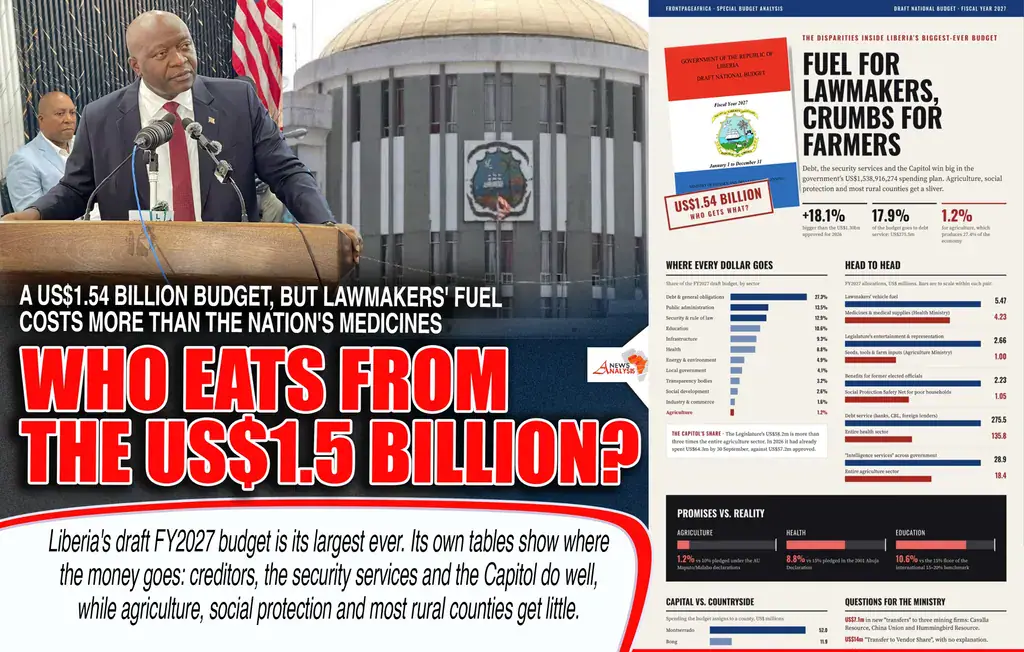
A thorough examination of the 845-page budget document reveals that a substantial portion of the funds is allocated towards debt service, security, and the Legislature. The largest single block, US$419.6 million or 27.3 percent of the budget, is categorized under "General Obligations and Programs," with US$275.5 million dedicated to debt service. This includes payments to commercial banks, the Central Bank of Liberia, and external creditors such as the World Bank. Notably, debt service now accounts for about one dollar in every five of core domestic revenue.
The security and rule-of-law sector is set to receive US$198.4 million, a 21.5 percent increase, with plans to recruit 600 police officers and between 800 and 1,200 soldiers. Additionally, the National Security Agency's budget rises to US$30.25 million, despite having already spent US$30.2 million by September 30, 2026, exceeding its 2026 budget by 22 percent. The Legislature's allocation stands at US$58.2 million, more than three times the entire agriculture sector and over four times the Ministry of Agriculture's budget.
Liberia's lawmakers and their staff are allocated US$58.2 million, with a significant portion dedicated to constituency visits, legislative committee hearings, and transfers to the Public Accounts Committee. Notably, the Legislature's vehicle fuel allowance increases by US$1 million to US$5.47 million, surpassing the Ministry of Health's entire budget for drugs and medical consumables. Furthermore, the Legislature retains US$2.66 million for "entertainment and representation," accounting for almost 77 percent of all entertainment spending in government.
In contrast, the agriculture sector, which contributes 27.4 percent to Liberia's economic output and employs a significant portion of the rural population, receives a mere 1.2 percent of the budget. The Ministry of Agriculture's allocation for seeds, tools, and other farm inputs stands at US$997,080, less than half of what the Legislature will spend on entertainment. The health sector also faces challenges, with an allocation of 8.8 percent, falling short of the 15 percent pledged by African governments in the 2001 Abuja Declaration.
The education sector is allocated 10.6 percent of the budget, below the internationally recommended 15 to 20 percent. The poorest households receive limited support, with the flagship Social Protection Safety Net allocated US$1.05 million, while benefits for former elected officials and those who have "elected and served" amount to US$2.23 million. Environmental sustainability, including forestry, the Environmental Protection Agency, and disaster management, receives a mere 0.7 percent of the budget.
Key sectors such as Monrovia, sport, and motorcyclists receive significant allocations, including a US$4 million "smart sanitation and city beautification" program and a US$2 million "Motorcyclist Empowerment Program." The Ministry of Youth and Sports' budget nearly doubles to US$18.2 million, with US$3.9 million in transfers to football, including US$3 million for the Lone Star national team. As the budget is implemented, it remains to be seen how these allocations will impact Liberia's economic growth and development.
Key points
- The budget prioritizes debt service, security, and the Legislature, while allocating relatively small shares to health and agriculture sectors.
- Liberia's agriculture sector receives only 1.2 percent of the budget, despite contributing 27.4 percent to the country's economic output.
- The Legislature's allocation is more than three times the entire agriculture sector and over four times the Ministry of Agriculture's budget.