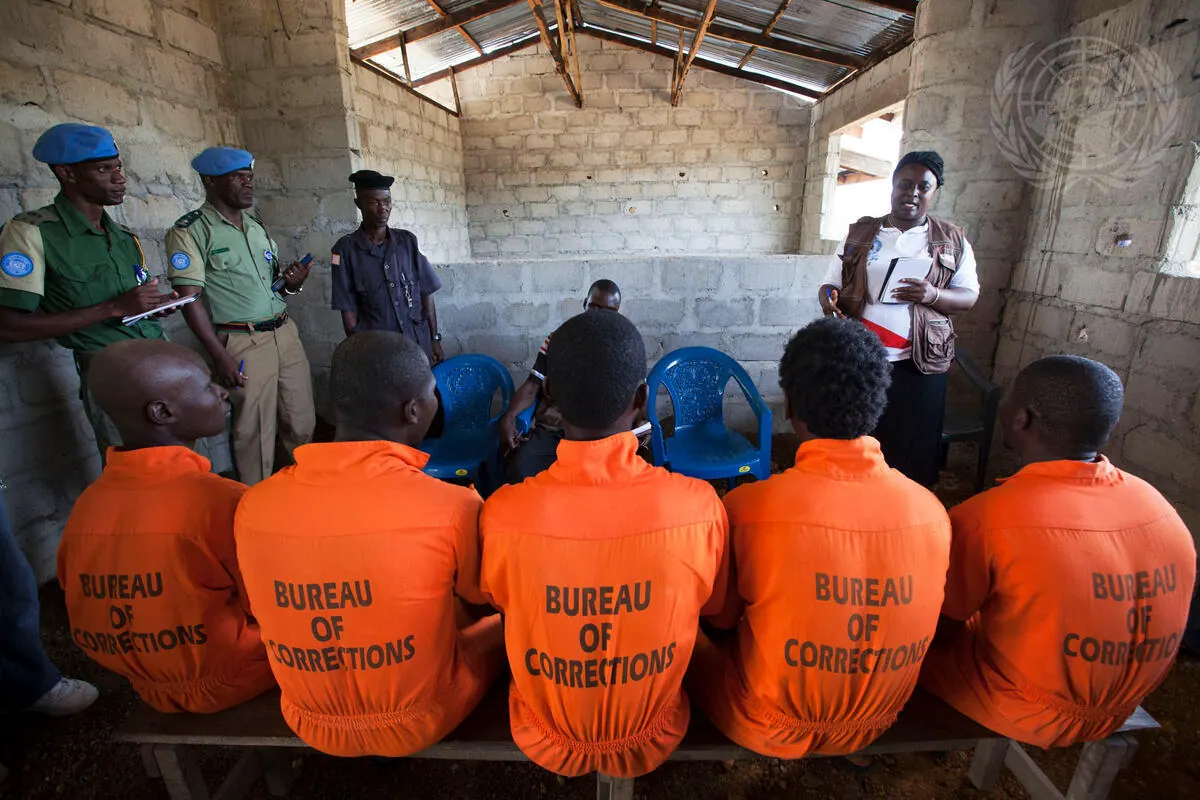
Liberia's correctional system is facing significant challenges, including severe overcrowding and inadequate infrastructure. The country has 16 prisons, with all but one, the National Palace of Corrections at Zwedru, operating beyond capacity. As of April 2026, the total inmate population stood at 3,711, against a designed capacity of 1,350. The Monrovia Central Prison, the largest facility, was built for 337 inmates but houses 1,794, almost half of the total inmates nationwide.
The overcrowding issue is compounded by the fact that 70% of Liberia's prison population has never been convicted of a crime. According to Assistant Minister of the Bureau of Corrections and Rehabilitation, Atty. Gabriel Ndupellar, 2,650 inmates are pre-trial detainees awaiting trial, while only 1,118 have been convicted. This situation highlights a systemic breakdown across the country's justice chain, with Ndupellar describing it as alarming.
The Liberia Correction Service Act, which aims to reform the correctional system, has yet to be passed into law. The proposed legislation seeks to establish the Liberia Corrections Service, a national agency responsible for managing and reforming correctional facilities. The agency will focus on improving prison infrastructure, professionalizing correctional services, and promoting rehabilitation and reintegration of inmates. The act also provides safeguards for inmate rights, rehabilitation programs, and enhanced training for corrections officers.
The current Bureau of Corrections and Rehabilitation, established in 1969, faces significant challenges, including budgetary constraints and prison overcrowding. The bureau is composed of three administrative subdivisions: the Bureau of Correctional Institutions, the Bureau of Probation, and the Board of Parole. However, the proposed Liberia Corrections Service will be a semi-autonomous paramilitary agency with only supervisory oversight from the Ministry of Justice.
Efforts to address the overcrowding issue include plans to relocate the Monrovia Central Prison to Cheesemanburg, where an administrative building was completed in 2014/15, and fencing of the facility has commenced. Some prisons, such as Sanniquellie, Voinjama, Kakata, Bopolu, Barclayville, Robertsport, and MCP, have space for expansion works. However, the delay in passing the Liberia Correction Service Act is hindering the smooth operation of correctional services.
Female incarceration rates vary significantly across counties, with Montserrado having the highest rate at Monrovia Central Prison, with 73 female inmates. Notably, there are more women incarcerated than sentenced in some counties. The data also shows that there are no female juveniles incarcerated or sentenced. Public defenders play a critical role in prison management, particularly in making motions for indigents who have overstayed their statutory period.
The Ministry of Justice's Division of Correction, comprising the Bureau of Correctional Institutions, the Bureau of Probation and Parole, and an Independent Parole Board, works closely with magistrates and public defenders to address prison management issues. The Bureau of Corrections and Rehabilitation has reported the systemic issues to stakeholders, including the Judiciary and human rights institutions, highlighting the need for a functioning justice system where convicted prisoners, not pre-trial detainees, constitute the majority of the prison population.
Key points
- Liberia's prisons are severely overcrowded, with 3,711 inmates against a capacity of 1,350.
- 70% of Liberia's prison population has never been convicted of a crime.
- The proposed Liberia Correction Service Act aims to reform the correctional system, focusing on rehabilitation and modernization.